
D. Jeffrey Mims is an American painter, educator, lecturer and muralist from central North Carolina. Born in 1954, Mr. Mims has devoted his life to continuing in the tradition of classical art, spending over 50 years in pursuit of mastery and dedicating long, intensive hours of self-study to connect with a form of art seldom practiced in contemporary contexts. In the early 1970s, Mr. Mims studied at the Rhode Island School of Design (RISD) and the Pennsylvania Academy of Fine Arts (PAFA), taking a somewhat unconventional approach through a system of self-propelled learning in an effort to uncover the language of master artists from past centuries. Having received the Elizabeth T. Greenshields Memorial Foundation grant in 1976, Mr. Mims embarked on travels to England, France and Italy where he furthered his investigation into classical painting, sculpture and architecture as an autodidact in these country’s museums, where he carried out mastercopies of famous paintings.In 1984, Mr. Mims had the opportunity to study with the American artist, Ben F. Long, where he was initiated into the lost art of fresco painting. For more than a decade, Mr. Mims held studios in both the US and Italy where he would come to refine his craft and execute his own easel and mural paintings, as well as complete commissions for a variety of churches, universities and private clients. In 2000, Mr. Mims founded Mims Studios in Southern Pines, North Carolina which was developed into the Academy of Classical Design within the next decade, to teach the sister arts of drawing, painting, mural design and how they can ultimately be framed through architecture. In 1984, Classical America presented him with an Arthur Ross Award to acknowledge his contributions to the classical tradition. In 2009, The Institute of Classical Architecture and Art (ICAA) awarded him an Affiliated Fellowship at the American Academy in Rome. Mr. Mims is a past member of the International Network for Traditional Building, Architecture & Urbanism (INTBAU) College of Traditional Practitioners. This interview took place between Mr. Mims and Emilio Longo via email correspondence between April, 2020 and January, 2025.
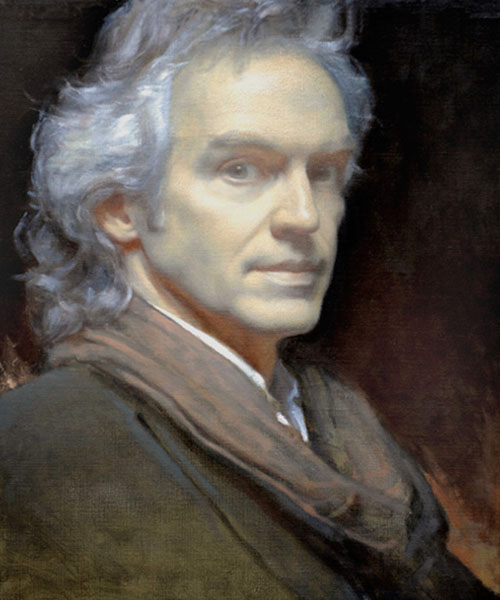
Underpainting for Self-Portrait, 2009. Oil on canvas, 20” x 16”. Private collection, US. Image courtesy of: D. Jeffrey Mims.
Mr. Mims, you were born during 1954 in North Carolina, USA. Reminiscing your childhood years, what influences did you have in your environment that drove you towards Classical Art and a love for beauty, balance and harmony?
It is a mystery to me why most all children like to draw and why, at a certain age, most stop. I was one of those who never did. My hometown of Southern Pines, (a small resort community in central North Carolina) had been shaped by a family of means with artistic interests. James Boyd, a poet and author of historical novels, with his wife Katharine entertained guests such as F. Scott Fitzgerald and Thomas Wolfe, at their ‘Weymouth’ estate, a center of Southern literary culture. The American painter, N. C. Wyeth illustrated Boyd’s books and as a result the town owns three original canvases from this partnership. For decades these paintings were displayed in our local library, and I recall being captivated by them as a child. Apart from a WPA mural in our post office, these oil paintings by Wyeth were the only original artworks I had ever seen.
My mother was a musically gifted woman who encouraged my artistic direction. She would save and label my earliest attempts at drawing and later would introduce me to books on different artists. I had no art teachers and somehow had the good sense to avoid art classes in high school. For me, drawing and painting were at that stage mostly an intuitive escape into imagination with occasional attempts at copying directly from Nature.
When the time came to select a college, my high school counsellor helped me to research the leading art institutions. I settled on the Rhode Island School of Design (RISD) and to my surprise, was accepted.
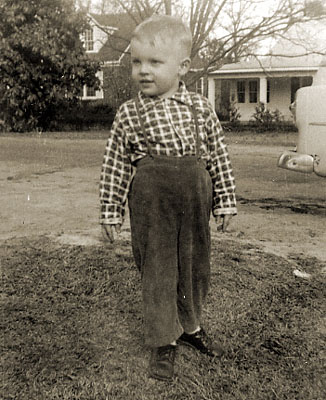
Mr. Mims at age 3, standing in front of his family home in North Carolina, c.1957. Image courtesy of: D. Jeffrey Mims.
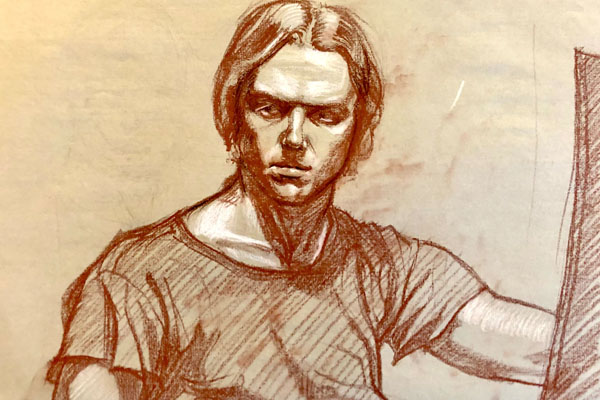
Self-Portrait Drawing at Age 19, 1973. Sanguine and white chalk on toned paper, 12” x 14”. Private collection, US. Image courtesy of: D. Jeffrey Mims.
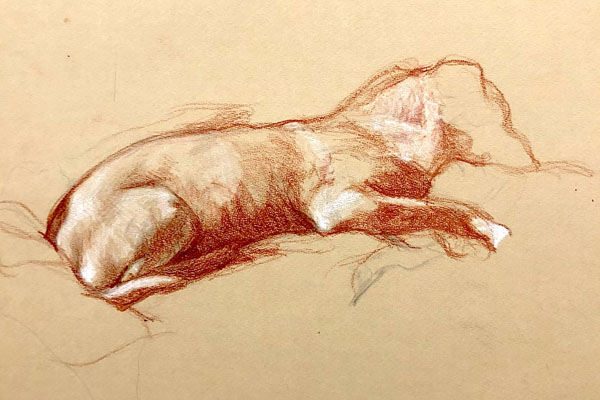
Sleeping, 1972. Sanguine and white chalk on toned board, 16” x 20”. Private collection, US. Image courtesy of: D. Jeffrey Mims.
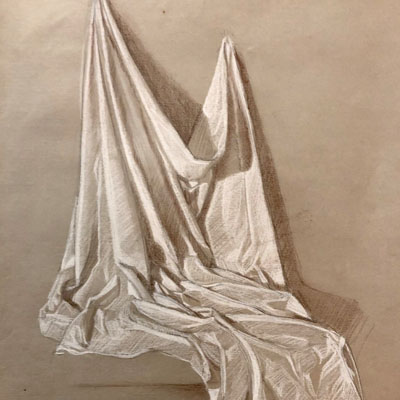
Drapery Study, 1973. Sepia and white chalk on toned paper, 24” x 20”. Private collection, US. Image courtesy of: D. Jeffrey Mims.
In 1972 you began your training at the Rhode Island School of Design (RISD), a decision which seems fairly normal for a young art student yearning to learn more about art in general. Can you provide an overview of your time and training at RISD including your initial impression of the institution, the curriculum which was propagated, teachers of particular influence, and the general philosophy and expectations of the institution?
My experience at the Rhode Island School of Design was not unlike what a student might find in most art colleges today. The most polite thing I can say is that for someone who had expected to study the art of drawing and painting, it was a very expensive lesson in irrelevance.
Though I remained enrolled for that first year, I soon stopped attending RISD’s foundation courses and found part-time work at a picture frame shop in Providence while continuing to draw and read in my free time. A favorite book among the few I owned featured the work of N. C. Wyeth’s son, Andrew Wyeth. He was the only living artist that I was aware of, and I still marvel at his work.
Through a remarkable coincidence, a family from my hometown had a summer place near the Wyeth’s hometown of Chadds Ford, Pennsylvania. They were kind enough to put me in contact with the caretaker for the Wyeth family. As a result, during winter break I travelled down to that part of the country which, in a strange way, was already familiar to me through reproductions and books. On my arrival I spent time hiking alone through the surrounding landscape, seeing first-hand many of the iconic locations that had inspired Wyeth’s paintings. Later that afternoon I was given a tour of the artist’s home and toward the end of my visit myhost exclaimed ‘here comes Andy now!’ Sure enough, a station wagon came bounding down the driveway, with Wyeth behind the wheel. As his car came to a stop, the door opened—and as I recall, four or five dogs jumped out before I caught sight of the famous artist. He had been out painting all day but was courteous enough to spend the next few minutes speaking with me. While this visit remains my most treasured memory from that first year of college, it would not be the only time during that period that I would make the journey from Rhode Island to Pennsylvania.
Toward the end of the academic year, I met another student who had become disenchanted with his own experience at RISD. He told me of his plan to investigate the Pennsylvania Academy of Fine Arts (PAFA) in Philadelphia, which had a reputation for traditional training, and invited me to come along. Indeed, it is the oldest art school in the United States with an impressive history, so off we went.
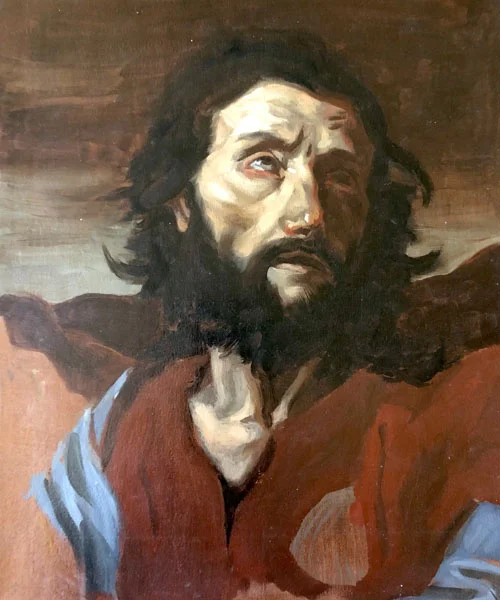
Museum copy after Ribera (Saint James the Great), 1974. Oil on gessoed paper, 16” x 14”. Private collection, US. Image courtesy of: D. Jeffrey Mims.
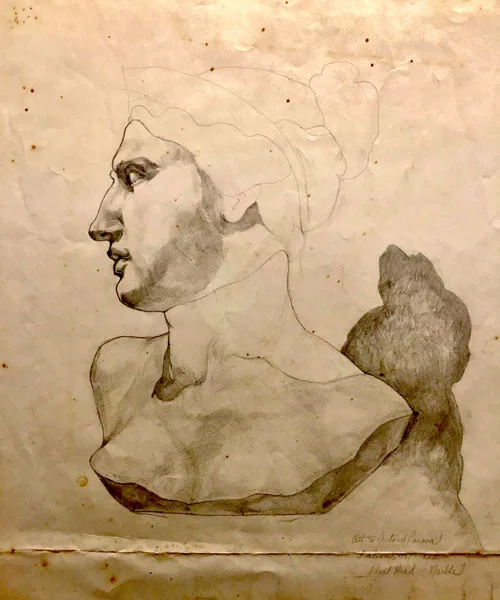
Drawing of Female Bust, 1972. Graphite on paper, 18” x 16”. Private collection, US. Image courtesy of: D. Jeffrey Mims.
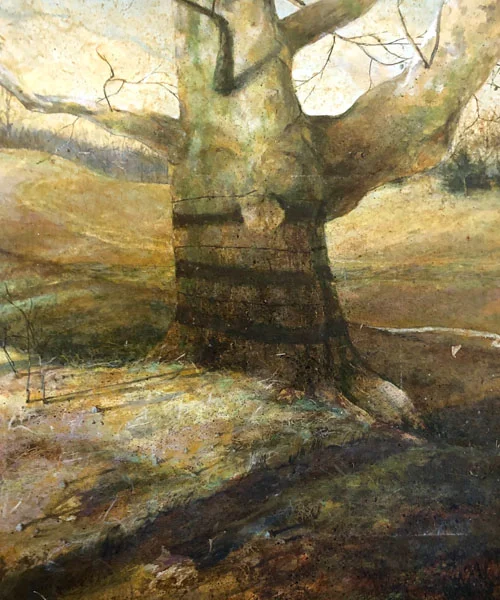
5 o’clock, 1974. Acrylic on board, 20” x 15”. Private collection, US. Image courtesy of: D. Jeffrey Mims.
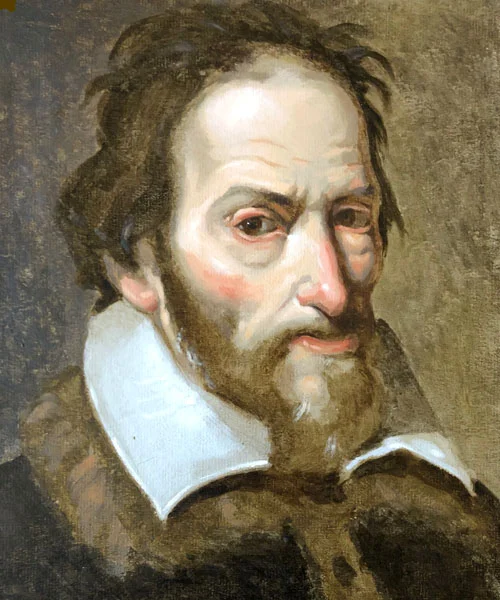
Museum copy after Strozzi (Portrait of a Gentleman), 1975. Oil on gessoed paper, 16” x 12”. Private collection, US. Image courtesy of: D. Jeffrey Mims.
Toward the end of 1973 and after almost one year of enrolment at the Rhode Island School of Design, you decided that the school was not the best option for you, so you inquired about the Pennsylvania Academy of Fine Arts (PAFA) in Philadelphia, as you’ve explained. Can you describe your first visit to the Academy, including your initial impressions of the environment and the training, as well as how it compared to RISD?
As I recall, the thing that captured my imagination and convinced me to enrol at the Pennsylvania Academy of Fine Arts the following year had little to do with its teachers, studios or student work. It was the historic Furness-Hewitt building itself with its own art museum, richly ornamented interior and mural painting by Benjamin West. As it turned out there was little interchange between the museum and the art school below, but the original concept remains a brilliant adaptation of historical models—like the Louvre, or the Vatican or other princely collections that had earlier been made available to train artists—long before they evolved into public museums.
In the autumn of 1973 when I began my first year at PAFA I still had no clear concept of what to expect from an art school and relied on instinct for what to pursue and what to avoid. I recall having been impressed with a reproduction in one of my books of a cast drawing by Delacroix after a Parthenon metope. Nothing I could find in the work of either students or instructors at the academy came close to the qualities I admired in this drawing. At this point I was developing a vague, if romanticized notion of what traditional training had been for artists of past times and so, in the absence of a convincing PAFA curriculum, I set my own course of independent study while enrolled. I read, studied anatomy, copied in the Philadelphia Museum of Art and drew from the academy’s plaster cast collection. In those days there were only a few plaster casts scattered around the studios and those that were available tended to be in awkward locations—not very well maintained at that. Almost 50 years later, I am happy to see that the academy’s wonderful collection of plaster casts has been preserved and even used as a recruitment tool in response to the current revival of cast drawing.
By my second year I learned of another building owned by the academy where many of the smaller casts were kept in seldom used studios. The scarcity of other students allowed me to set up directional spotlights without disturbing anyone—a vast improvement over the multidirectional florescent lighting under which I had been trying to draw in the main building. These nearly abandoned rooms seemed to me like magical spaces and became my classrooms over the next three years. At the same time and with unimpressive results, I drew from the academy life models and experimented with paint, but I was in no hurry to abandon my exploration of cast drawing.
It was during this period that two other things happened that would have a lasting influence on my education and future direction. The first was my discovery of the book, published just a few years earlier in 1971, titled The Academy and French Painting in the Nineteenth Century by Albert Boime. Not an easy read, this window into the teaching practices of the French Academy nevertheless provided a model that I felt could be adapted to my own search for a meaningful curriculum. Then in 1975, the Metropolitan Museum of Art hosted a travelling exhibition titled French Painting 1774 – 1830: The Age of Revolution. Viewing these astonishing works was an opportunity to see firsthand much of what Boime had described in his research and it also introduced me to the classicizing work of J. L. David.
Because I had opted out of scheduled critiques at PAFA, I was required to sign a document stating that I would be ineligible for any prizes or scholarships. For the next two years, I was enrolled under this unusual arrangement and remained unofficially for a third year to continue working from the plaster cast collection. This was possible because by that time I had become a familiar figure on the premises, working part time as school janitor and managing the museum bookstore on weekends.
Despite not having found the training I had hoped for, I realized that certain resources available to an enrolled student might be denied to someone untethered to an institution. One such advantage was special permission granted to academy students interested in the study of anatomy. Through a special arrangement with a Philadelphia hospital a small group of academy students were allowed to draw from the cadavers being used to train medical students. I had been studying the subject from books, copying illustrations and memorizing the names of bones and muscles but like others in our group, I was quite unprepared for that first encounter with reality.
In the weeks that followed, I made several more trips to draw from the dissections. I do not recall that any of the other academy students ever returned, but in the end, the experience was probably less important for the training of a painter than it was an occasion to reflect on the mystery of life itself.
A much more poetic approach to the study of anatomy was made available to PAFA students in those days by the legendary Robert Beverly Hale. Mr. Hale travelled down to Philadelphia from New York several times each year to deliver his remarkable lectures, and anyone who has watched the grainy black and white video series from that era will likely understand why his visits were such an anticipated event in the school year. Mr. Hale’s lectures were presentations, but not really opportunity for discussions. They were, like the study of mathematics or philosophy, an introduction to a different way of thinking—specifically, thinking about drawing as a mental construction rather than visual imitation.
While I was enrolled at PAFA in the mid-1970s, there was one other teacher who encouraged a traditional approach, and I made it a point to attend each of his demonstrations. Arthur DeCosta, a highly respected instructor with a loyal following, taught from 1966 to 1988. I recall Mr. DeCosta would use the imperfect term ‘classical realism’ to describe his own work at this time. This is to take nothing away from the often-repeated account that the phrase had been coined by Richard Lack in the early 1980s. I see it rather as the affirmation of an idea whose time had come, and I am simply stating what I remember from that period.
A story that was circulating during my final year at the academy goes as follows. Apparently, the formation of an alternative art school with a much stronger historical approach was being considered by Mr. DeCosta, along with the sculptor, Evangelos Frudakis and the painter, Nelson Shanks. At the same time a Philadelphia gallery was exhibiting the work of Mr. Shanks whose work I had never before seen. He enjoyed a strong regional following but had yet to establish the international fame of his later years. The works on display were for the most part small, highly finished interiors with figures, not unlike updated versions of Dutch cabinet paintings. They were the finest work I had ever seen from a contemporary painter, and I marvelled that he was not better known.
In the end, for reasons I can only imagine, the alternative art school never materialized, but by that time I had already set my sights on a different and altogether new experience. A notice had arrived in the mail informing me that I had been awarded a Greenshields grant for independent study in the museums of Europe, and with this good fortune my education was about to expand beyond anything I had experienced during my college years.
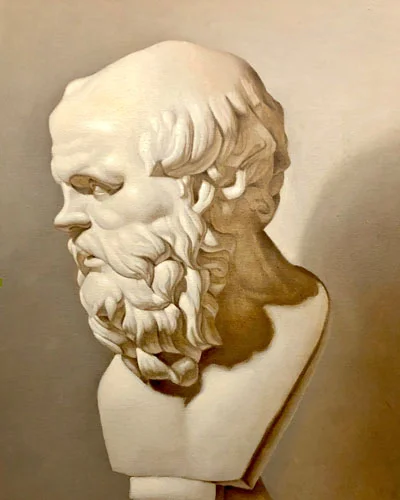
Socrates Painting, 1975. Oil on canvas, 24” x 20”. Private collection, US. Image courtesy of: D. Jeffrey Mims.
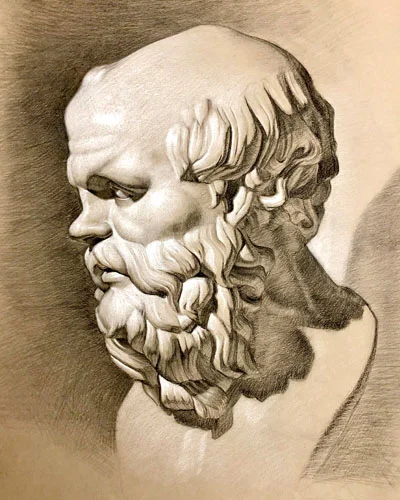
Socrates Drawing, 1975. Charcoal pencil and white chalk on toned paper, 24” x 20”. Private collection, US. Image courtesy of: D. Jeffrey Mims.
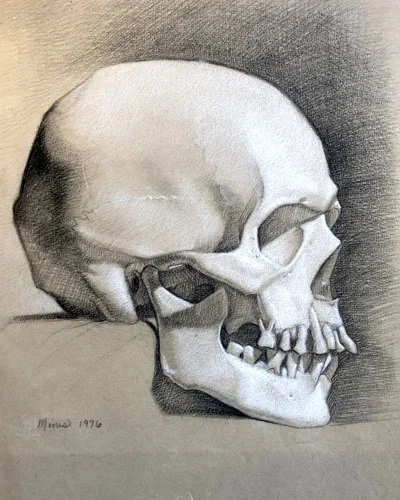
Skull Study, 1975. Charcoal pencil and white chalk on toned paper, 16” x 12”. Private collection, US. Image courtesy of: D. Jeffrey Mims.
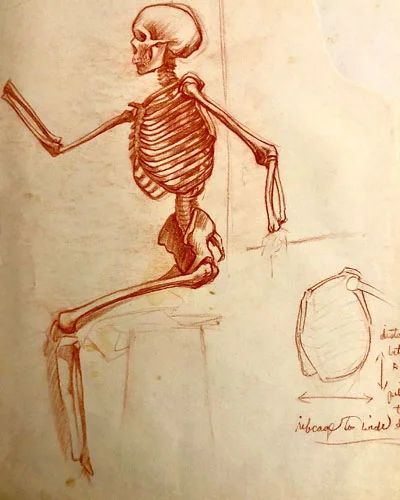
Skeleton Study, 1974. Conte chalk on newsprint paper, 24” x 18”. Private collection, US. Image courtesy of: D. Jeffrey Mims.
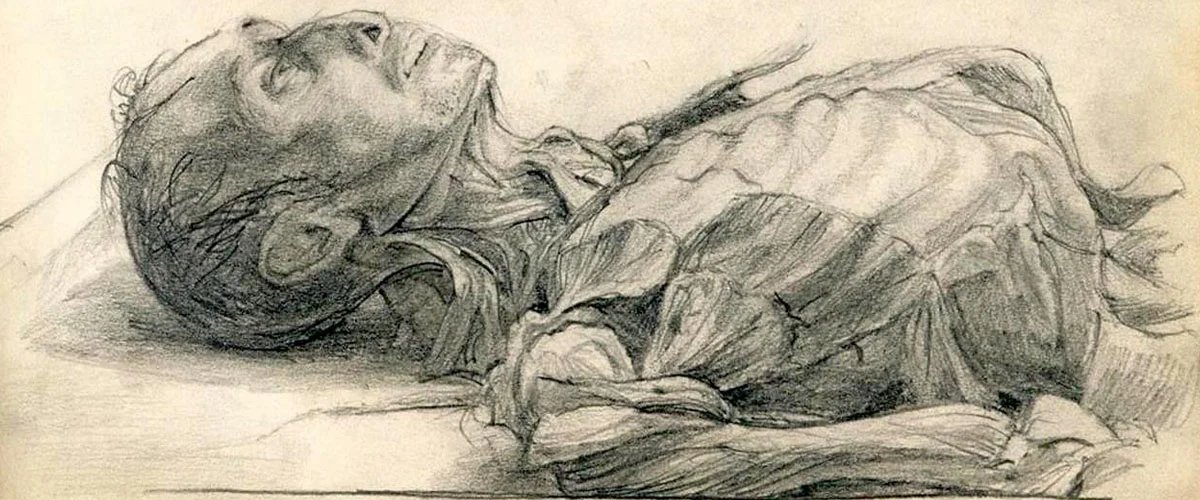
Anatomy Study, 1975. Graphite on paper, 5” x 7”. Private collection, US. Image courtesy of: D. Jeffrey Mims.
In 1976, you received an Elizabeth Greenshields Foundation grant which allowed you to travel to Europe and carry out self-directed study in the museums of Italy, France, and England. The Greenshields Foundation was established in 1955 by Charles Grass Greenshields who was a Montrealian lawyer and artist that created the foundation in memory of Elizabeth, his mother. Can you provide a detailed recollection of this period of individual study including your experiences of studying the work of master artists from life and how this benefitted your own development as an art student?
Having adapted to urban life in two different north-eastern US cities had been an education in itself for me, but easy enough compared to this next step. In an era before the internet began to homogenize regional cultures and Europe still maintained much of its historic identity, the prospect of crossing the ocean to live in a different country was as daunting as it was exciting. With the knowledge that now I really would be untethered to any institution or support group, I chose London as a home base. Language and cultural considerations certainly influenced my decision, but they were not the only reasons. During the previous four years I had never quite forgotten that illustration in my Oxford Companion to Art of Delacroix’s drawing after the Parthenon metope. I now believe that it was the appeal of antiquity and not just the drawing itself that sparked my determination to copy from the originals preserved in the British Museum.
London was in those days still recognizable as a city that had been built on a human scale. The inappropriate architectural additions that mar its skyline today were just getting started in the 1970s. The wonderful variety of museums is still there. Together with London’s philanthropic policy of making these collections available to the public for free, the city remains a model for civic education.
After several weeks of searching, I settled into an affordable, if not quite glamorous flat in Earl’s Court and began a regular schedule of drawing all day in the British Museum. Most art students I have known learn to * “live content with small means” and I was no exception. The first half of the year was dedicated to copying from the Parthenon’s frieze, metopes and pediment figures. These sculptures are displayed in a custom designed gallery under a diffused light source to accommodate detailed viewing. In the absence of directional shadow patterns, it became necessary to find a method of drawing that was quite different from what I had developed in Philadelphia. I focused instead on contour and idealized proportions, qualities for which the sculptures are held in such high esteem.
Working in a public museum, one becomes accustomed to (if never quite comfortable with) the people who gather to watch the progress of the copyist. One day another young man who had been watching for longer than usual, politely approached and offered his compliments on my drawing. I noticed that he spoke with an American accent and was carrying a portfolio, so I asked to see his own work. He had been copying from a bronze head of Hypnos, (the Greek god of sleep) and had produced what seemed to me, an exquisitely rendered graphite version of the original. This naturally made me curious to learn about his own training back in Minneapolis—and to make a long story short, it was my introduction to the circle of Richard Lack and Ives Gammell.
Among its many treasures, the British Museum also possesses one of the finest prints and drawings collections in the world. With proper documentation, scholars and artists could request to have priceless originals placed before them for the purpose of study. Among the many events that stand out from that momentous year was the opportunity to examine a number of master drawings up close and even copy from a Michelangelo original. And though I am thankful for the increasing quality of drawing reproductions available today, they will never capture what I can only call the spirit that lives in the originals.
Another one of London’s excellent institutions is the Victoria and Albert Museum. Known as the V&A, it owns the world's largest collection of post-classical sculpture, including several masterworks from the Italian Renaissance. The museum also holds a very fine prints and drawings collection of its own, and I was able to study firsthand a variety of historical techniques. My work in the British Museum had been largely influenced by engravings and were of a linear nature. The Italian sculptures in the V&A were by contrast, displayed under very dramatic lighting and provided the opportunity to experiment with several different methods of shading I had observed in certain 18th and 19th century drawing portfolios.
Halfway into the year I began dividing my time between making these drawings and painting copies in the National Gallery. I began with a small head study by Ingres, then a mythology by Boucher before graduating to a larger landscape by Claude and finally a just-under-life size copy of Correggio’s Venus with Mercury and Cupid.
It was around this period that I discovered the work of Frederic Leighton, whose reputation had barely begun its re-ascent. The Leighton House Museum was at that time such a well kept secret that I rarely came across another person during my visits. I might have mistakenly assumed Leighton to be another of the many under-rated Victorian Classicists who were beginning to resurface—except for one work in particular – titled, The Arts of Industry as Applied to Peace. One afternoon during my exploration of the massive labyrinth that is the V&A Museum, I came across this monumental mural that had been designed by Leighton. It was crowded into an odd, dimly lit corridor making it difficult to see, which I later discovered was due to a poorly planned museum renovation. Even in its damaged state, this singular work should, in my opinion, assure Leighton’s place among the world’s greatest designers of mural painting.
Following that year in London I travelled to Paris in 1978 for an additional two months to study in the Louvre. The little bit of French I had learned in high school was just enough to help me obtain a copy permit. The memory of that Metropolitan Museum exhibition that had introduced me to the classicising style of David several years earlier was still strong and my hope was to copy something by him during my short stay in Paris. Seeing his major paintings gathered in one place only served to confirm my admiration for his work and it was not difficult to understand how such an artistic revolution had dominated European painting for a generation. Despite the limited time, and occasional bureaucratic obstacles, I was able to paint a reduced copy of one of the figures from his Battle of Thermopylae and will always be grateful for the experience.
As anyone who has visited the Louvre will know, it is an enormous space and the walk to my easel each day was a journey through the history of art and architecture. The same could be said of Paris in general. On days when copy work was not permitted in the Louvre, I was free to visit the many other museums, churches and monuments that have played such important roles in the history of this city.
With time and money almost gone I knew that I could not miss the chance to see Italy before returning home. Anticipating this final chapter of my tour, while back in London, I had enrolled in an Italian language course to learn a few basic phrases. Today, when an English speaking student travels to Italy to study with one of the many university abroad programs or private art schools, they can be assured to find a community of compatriots to help ease the cultural transition, but in those days, you were on your own. My journey south began with an overnight train ride to Rome where I remained for one week. Using a budget travel guide I was able to locate and visit a number of cultural landmarks in the Eternal City. Not surprisingly, among the many artistic treasures that I recall best from that whirlwind tour was Michelangelo’s Sistine Chapel ceiling. This was before the ‘restoration’ that took place between 1980 and 1994. The overwhelming sense of wonder that I experienced with my first encounter of the Sistine ceiling would be sadly diminished during the successive years of what many consider having been misdirected cleaning.
The final week in Italy was reserved for Florence, birthplace of the Renaissance and one of the most charming cities in the world. I realized during that short stay that I would have to find a way to return here someday.
When I consider how the Greenshields grant benefited my development as an art student, I am faced with the difficulty of summarizing an experience that continues to shape my taste and judgement over forty years later. The grant made possible the privilege of travel that I could not have otherwise afforded. It allowed me to remain for extended periods of time in locations that were important not only for artistic study but also for cultural understanding. A common thread connecting each encounter was the opportunity to see firsthand the profound thought and execution that went into so many fine works of art. The priceless collections made available for free in London affirmed my reverence for the Antique. Days spent in the museums of Paris served to broaden my vocabulary of art history. And though I could not have defined at the time what captivated me most from my first visit to Italy, I would now describe as the sense of ‘design’ used to orchestrate rchitectural space with its painted and sculpted decoration.
It was not until I had returned home that I had time to reflect on how these new experiences might be adapted to the life of a contemporary painter. The European collections that had shaped my perceptions of quality were poignant reminders of how much we had lost in our own time. The one thing I did feel certain about was the need to learn more.
*To live content with small means; to seek elegance rather than luxury, and refinement rather than fashion; to be worthy, not respectable, and wealthy, not rich; to listen to stars and birds, babes and sages, with open heart; to study hard; to think quietly, act frankly, talk gently, await occasions, hurry never; in a word, to let the spiritual, unbidden and unconscious, grow up through the common -- this is my symphony. -William Henry Channing, clergyman and reformer (25 May 1810-1884).
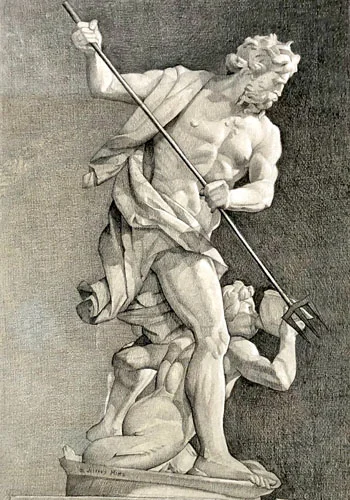
Drawing after Bernini’s Neptune and Triton from the Victoria and Albert Museum, 1978. Charcoal pencil and white chalk on toned paper. 20” x 14”. Private collection, US. Image courtesy of: D. Jeffrey Mims.

Drawing after fragment of marble sepulchral relief from the British Museum, 1977. Charcoal pencil and white chalk on toned paper, 17” x 12”. Private collection, US. Image courtesy of: D. Jeffrey Mims.
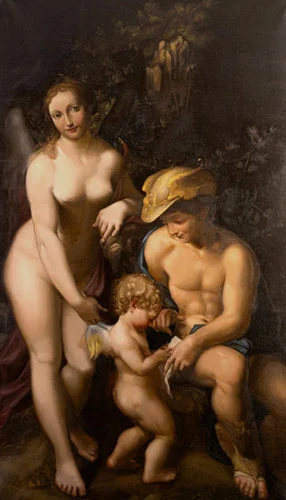
Museum copy after Correggio (Venus with Mercury and Cupid – The School of Love), 1978. Oil on canvas, 44” x 26”. Private collection, US. Image courtesy of: D. Jeffrey Mims.
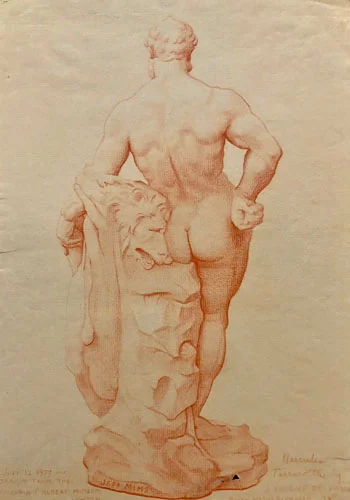
Drawing after terracotta Hercules from the Victoria and Albert Museum, 1977. Sanguine and white chalk on toned paper. 13” x 9”. Private collection, US. Image courtesy of: D. Jeffrey Mims.
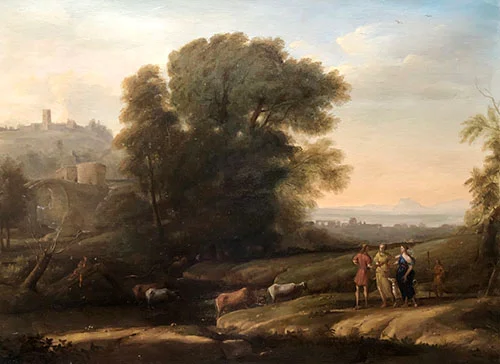
Museum copy after Lorrain (Landscape with Cephalus and Procris reunited by Diana), 1977. Oil on gessoed paper, 18” x 24”. Private collection, US. Image courtesy of: D. Jeffrey Mims.
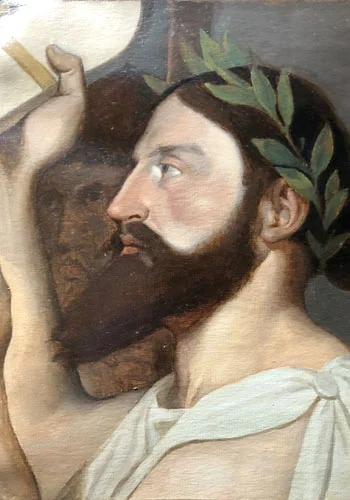
Museum copy after Ingres (Pindar and Ictinus), 1978. Oil on gessoed paper, 14” x 11”. Private collection, US. Image courtesy of: D. Jeffrey Mims.
After your travels to Europe and your immersion in the Classical tradition, you returned home to North Carolina in 1978. Can you explain the course of your life between this time and 1981, when you decided to return to Florence?
The years immediately following my first tour of Europe in 1977 offered a much more prosaic backdrop to my development as an artist. Death had recently taken both of my paternal grandparents—a situation requiring a temporary caretaker for an elegant old home in Durham, North Carolina where, for a while, I was able to live rent free. Most days I worked for a large bookstore chain in a nearby shopping mall.
Having obtained permission to use the library at Duke University, my evenings were often spent in a random exploration of art history. I remember one visit in particular, when just by chance, I discovered the art and architecture of what has been called the American Renaissance (1876 to 1917) through the writing of Edwin Blashfield—the leading mural decorator of that era and author of the book, Mural Painting in America. Blashfield belonged to a generation of artists and architects who introduced the Beaux Arts tradition in the US with projects such as the Jefferson Building at the Library of Congress in Washington, DC.
Images from this period suggested a way forward to my previous question of how an artist might adapt a European experience to a contemporary career. The Beaux Arts tradition offered a role to the painter that was part of a carefully integrated architectural design program. It was a role that held great appeal for me—though it would be many years before I would be presented with the opportunity to design a project of such scope.
A copy of Nicolas Chaperon’s Nurture of Jupiter still hangs in my studio as a reminder of that year in Durham. On my days off from working at the bookstore, I had arranged permission to paint a copy of this masterwork which was displayed in the newly formed Ackland Art Museum at the University of North Carolina at Chapel Hill. Nicolas Chaperon was a French painter and engraver, and a student of Simon Vouet before working with Nicolas Poussin in Rome (1642–51).
At some point during this interim period, I recall making a trip back up the east coast of the US in search of the few slim leads collected during my time abroad. Making my way to Boston’s Fenway Studios I contacted a painter named Jan Gendron who showed me several very accomplished pastel portraits he had recently completed. There was a truth to nature and a broad way of seeing in his work which I noticed and admired. Jan was kind enough to attempt an impromptu introduction to Ives Gammell, however, the legendary man had left for the day and such a meeting was not to be.
From Boston I travelled back down to Philadelphia to visit my old school, the Pennsylvania Academy of Fine Art. During this visit I was introduced to Bo Bartlett, a talented new student gaining recognition among the circle of figurative painters there. Impressed with his ability and curious about his background, I was surprised to learn that he was a fellow Southerner and had previously studied with a painter from North Carolina by the name of Ben Long. The story became even more interesting when Bo told me that Ben was planning to paint a fresco in the mountains of North Carolina and might be looking for assistants. Not long after receiving this information I was somehow able to track Ben down in Western North Carolina. Working out of a historic studio that had belonged to the 19th century artist Elliot Dangerfield and fresh from a nine-year apprenticeship with the Italian Maestro Pietro Annigoni, Ben was indeed organizing a major fresco commission that was granted by the priest at the local Holy Trinity Episcopal Church and invited me to join a team of artists and students who would be working with him on the project the following summer.
I wonder if we ever really recognize an experience that is destined to be of lasting influence when we first begin down a new path? It certainly felt like a significant turning point when I was initially introduced to Ben’s work. He had recently completed his first major American fresco for a small church in a most improbable rural location. I recall seeing a portrait commission on his easel at that first encounter—but it was his draftsmanship that was so compelling. It was unlike anything I had seen in contemporary work. It seemed to embody a sort of mystical connection to tradition in the way that Renaissance artists had emulated antiquity. It was not an imitation of any one tradition, but a style profoundly informed by the history of art and entirely his own.
Meanwhile, back in my hometown of Southern Pines, Katharine Boyd, the matriarch of the aforementioned Boyd family had died leaving the Weymouth estate to be rescued by a local preservation group. A non-profit calling itself the ‘Friends of Weymouth’ was created in 1979 repurposing the house and grounds into a local cultural center. My mother suggested to me that I propose the idea of an ‘artist in residence/caretaker’ during the organization’s formative period. The proposal was accepted, and I spent an idyllic year in this setting, using a small carriage house on the grounds as a studio and waiting for the call to begin the fresco in the mountains with Mr. Long.
The summer of 1980 finally arrived, and I was one of twenty artists invited to Glendale Springs, a tiny community tucked away in the mountains of North Carolina, to assist and learn the ancient technique of fresco painting with Ben Long. It was hard volunteer work, but a learning opportunity that we felt honored to be part of. The local community provided lodgings for our group, and we took our meals at the church’s mission house—thanks to generous donations from neighboring gardens.
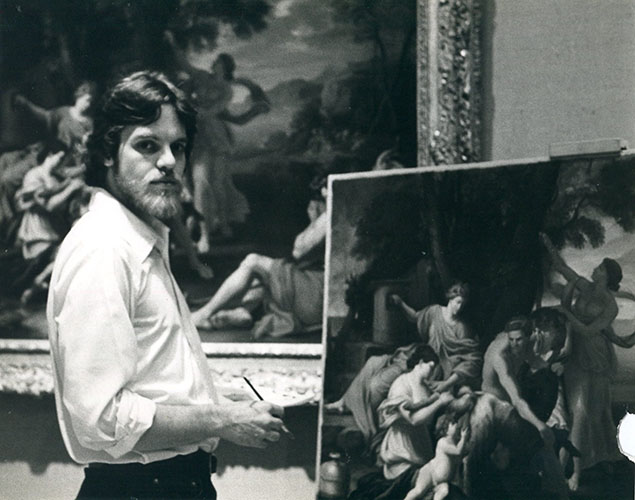
Mr. Mims working on his museum copy after Nicolas Chaperon’s painting, The Nurture of Jupiter, within the Ackland Art Museum at the University of North Carolina, at Chapel Hill. 1978. Image courtesy of: D. Jeffrey Mims.
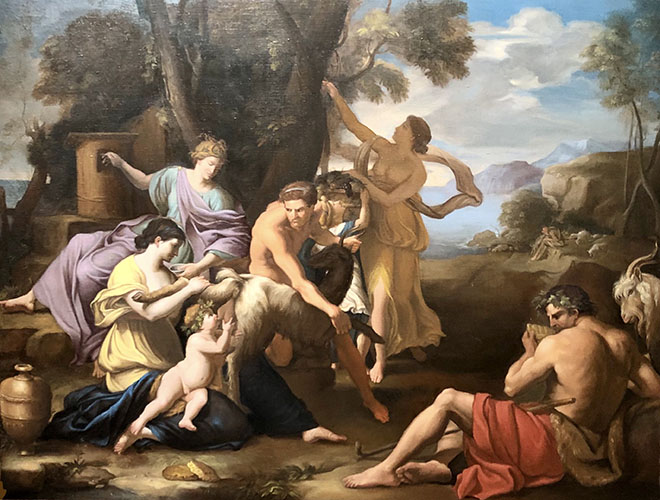
Museum copy after Chaperon (The Nurture of Jupiter), 1978. Oil on canvas, 44” x 34”. Private collection, US. Image courtesy of: D. Jeffrey Mims.
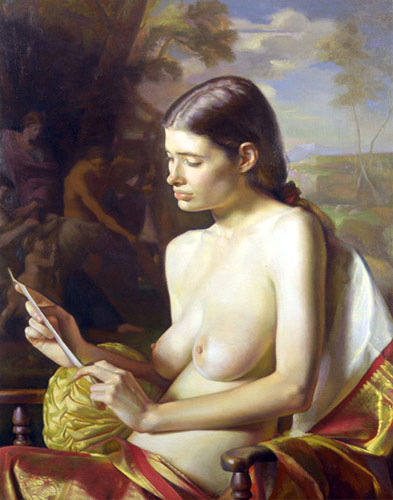
The Nurture of Jupiter, 1994. Oil on canvas, 30” x 24”. Collection of Oglethorpe University Museum, Atlanta, GA. Image courtesy of: D. Jeffrey Mims.
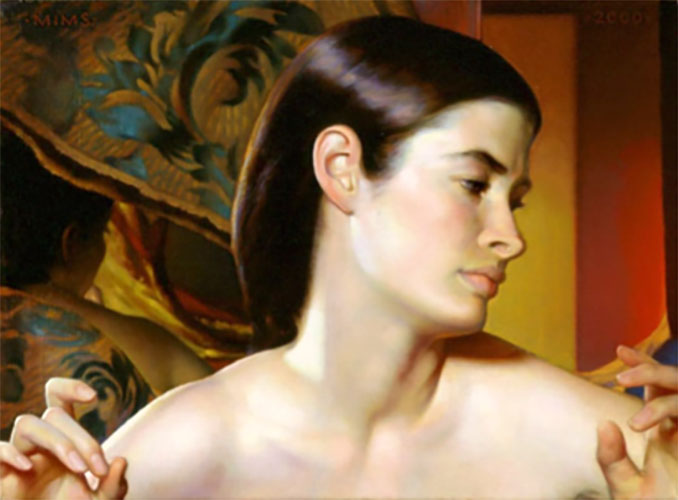
Intuition, 2000. Oil on canvas, 19” x 24”. Private collection, US. Image courtesy of: D. Jeffrey Mims.
The summer of 1980 in Glendale Springs, NC sounds like it would have been an artistic utopia for an art student. I understand Ben Long and Charles Kapsner were responsible for your initiation into the art of fresco painting during this time. Can you outline the principles and methods of the craft that were disseminated upon you?
There was no formal instruction on the art of fresco painting, but Ben got right to work and encouraged everyone else to participate in his process of making drawing studies from live models. Charles Kapsner was the principal assistant. Charles had studied with Signorina Simi in Florence where he had known and worked with Ben on a previous fresco project. The technical experience and sense of organization that Charles brought to the undertaking cannot be overstated. He acted as a buffer between Ben and the constant stream of tourists who came to see the progress—as well as a patient guide to those of us who were being initiated into the secrets of fresco painting.
Fresco is an art requiring a great deal of advance preparation. The subject of this fresco was to be a ‘Last Supper.’ This theme with its rich history of precedents was also one of Annigoni’s last fresco commissions—in which Ben had participated—not only as assistant but also as model for one the disciples.
Based on compositional sketches that Ben adapted to the architectural design of this simple mountain church, drawings were made for each of the figures. Once individual gestures had been determined, studies were then prepared for details of hands, feet and especially each of the portrait heads.
As assistants we took turns with the technical work of grinding colors, washing brushes, mixing plaster, and risking our lives carrying supplies up and down a rickety old wooden ladder attached to the scaffolding. On days when we were not assisting, we were encouraged to try our own smaller, experimental fresco compositions. The results—though a profound learning experience—seemed to me like the fall of Icarus who was given wings before he was ready to fly. Nevertheless, it was an unforgettable experience to work with Ben and observe firsthand his own profound mastery of fresco painting. Toward the end of that summer, as the project was reaching its conclusion, a few of us approached Ben with the idea of following him to Florence to continue studying with him. It was agreed that such an arrangement would be organized to begin at the start of the following year and so I returned to the Weymouth studio in my hometown of Southern Pines with the goal of selling what I could and saving what I could in order to be able to afford the journey back across the ocean and into a very uncertain future.
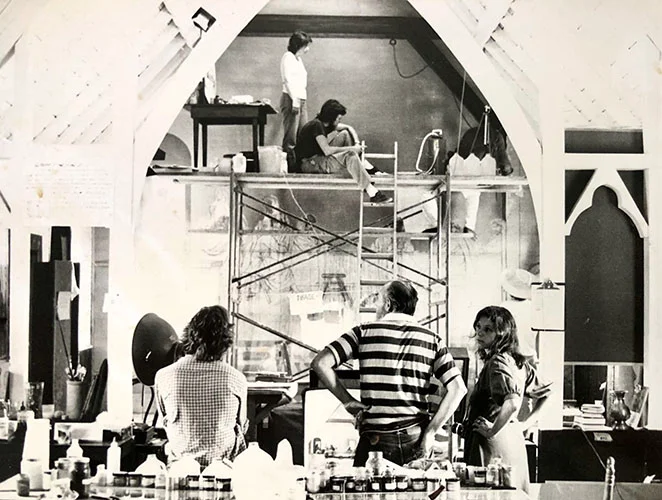
Ben Long working with his assistants on his fresco in Glendale Springs, NC. 1980. Mr. Mims is sitting at the top of the scaffolding. Image courtesy of: D. Jeffrey Mims.
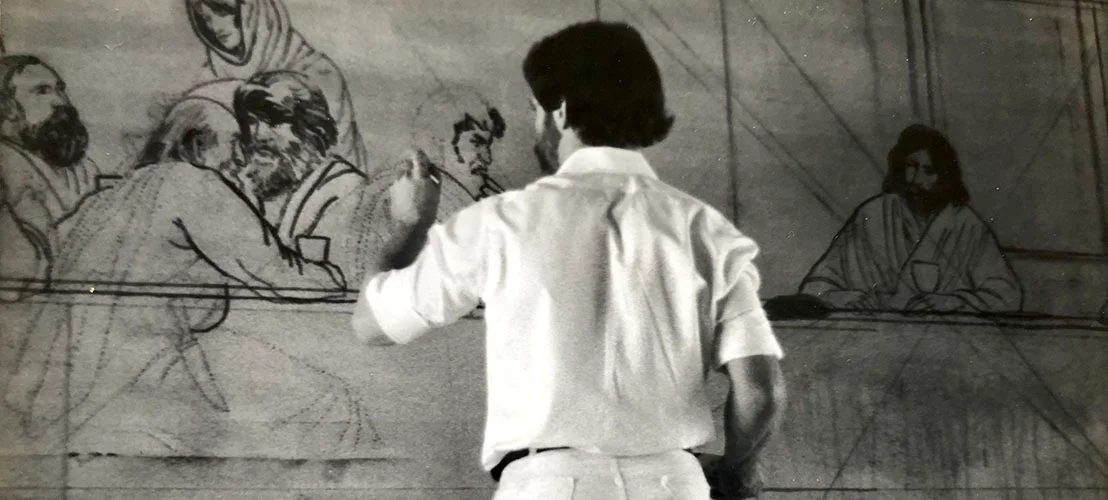
Ben Long painting the sinopia on his fresco in Glendale Springs, NC. 1980. Image courtesy of: D. Jeffrey Mims.
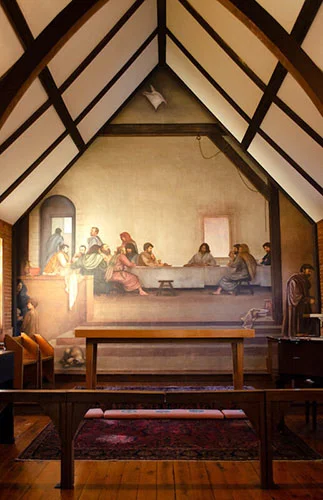
Ben Long’s finished fresco within Holy Trinity Episcopal Church in Glendale Springs, NC. 1980. Image courtesy of: www.benlongfineart.com
In 1981, after the experience of assisting with painting the fresco in Glendale Springs, NC, I understand you along with some fellow students travelled with Mr. Long to Florence to continue your training, as you have mentioned. During this time, you were able to penetrate deeper into the Classical and Renaissance traditions. Can you recall your memories of this trip and share any stories of relevance?
I will never forget that first night in Florence. The year was 1981. Ben had made overnight arrangements in a pensione that was closed for the winter season. I spoke no Italian at that point and was thankful to have a place to rest after the long journey—despite there being no heat in that freezing building! But the memory of that harsh first night would soon be replaced by the many magical events that followed. In a stroke of good luck, (or divine providence) I was introduced to a kind Irish woman who owned a historic hotel in Piazza Santissima Annunziata, perhaps the most beautiful and harmonious Renaissance square in all of Florence. Here in this extraordinary location, free lodging was arranged in exchange for working a shift each day in her hotel lobby. And so, with careful management of expenses, the ‘uncertain future’ accompanying my arrival could now likely be extended to an entire year.
I believe I am safe in stating that back in those days the only studio in Florence with the organization and knowledge to teach traditional methods of drawing and painting was that of Signorina Simi, daughter of the 19th century realist painter, Filadelfo Simi. I recall visiting the school once, early in the year as a guest of one of her former tudents. Filadelfo’s large scale genre paintings of rural life in Italy that dominated the studio walls were without a doubt, among the most masterful works I had seen outside of a museum.
As far as I am aware, the first group teaching experience for Ben in Florence was with three other students and myself. His approach to teaching oil painting was similar to the way that he taught fresco. The technique of tempera-grassa, used by Annigoni was never discussed in detail nor was there much curiosity from our group to explore that direction. We did receive valuable instruction in the use and preparation of materials, such as preparing gesso panels and grinding our own oil paints but concerning the making of images we were simply allowed to work with Ben from models he selected. We observed his process while we experimented with our own versions of his method. This consisted of a very effective use of a grisaille underpainting to support a succession of glazes, scumbles and layers of opaque color—adapted for different effects. There was no question that his mastery of drawing and his technique of oil painting was beyond anything I had witnessed, so I struggled on despite my results. There was something of the monumental in his finest work which I felt set him apart from others. This hard to define quality seems to have developed from individual temperament and was noticeably different from Annigoni’s later style during the period when they had worked together.
Regarding any awareness of contemporary practice at this point, I should probably mention that I had seen a few examples of Ives Gammell’s work, which I admired but found to be rather awkward. During my time in Philadelphia, I had seen a number of paintings by the technical wizard, Nelson Shanks and I had also been quite inspired by reproductions of the early work of Charles Pfahl, which I knew from his book, ‘Artist at Work.’ I was yet unaware of his teacher, John Koch who had died in 1978 and whose paintings deserve to be much better known. Later during this first year in Florence, I was to meet Richard Maury a number of times and become familiar with his own extraordinary work. Andrew Wyeth remains in his own independent, exalted category.
To me these were the painters who had surfaced as the best hope to rescue the endangered tradition of painting. Consciously or not, they were part of (in the words of Richard Lack’s 1985 book) ‘Realism in Revolution’. Yet, as much as I admired their accomplishments, in almost every case their work seemed closer to the tradition of genre painting than to an evolution of the Classical tradition of history painting—which I was still hoping to discover somewhere in contemporary practice.
The training in Ben’s studio consisted primarily in working with him from a portrait model in the mornings. The studio remained at our disposal for independent projects in the afternoons and as I recall reasonable fees for this arrangement were collected to cover studio rent and model expenses. It was a spacious room with a remarkably high ceiling and north light window. Years earlier it had been constructed with a unit of specially designed artist studios. The light and space were wonderful, but other than a source of cold water, there were few comforts, not even heat in the winter. On certain evenings Ben would hold figure drawing sessions at his home studio and invite other artists to join. It was at one of these sessions that I first met Rob Wraith, a talented English painter who had also worked with Annigoni during the maestro’s later years.
My own tendency has always been to work alone. For me, the concentration and imagination necessary to artistic production require a measure of solitude. Ben, on the other hand, appeared to thrive in the presence of an audience. He was generous with his knowledge, and I remained to work with the group for several months. During this time, I learned a great deal about traditional oil painting methods, and I completed several small portrait panels with reasonable success. Gradually my nocturnal nature began to reassert itself and I stopped attending the morning group sessions. In the afternoons I began a series of independent studio interiors. The technical knowledge gained during this year in Florence was of immense value, but there was another indirect lesson I learned from Ben—one for which I will always be grateful—and that was his example of an artist’s life devoted to the integrity of the profession.
One day during my shift in the hotel lobby, a guest left their copy of ‘The Agony and the Ecstasy’ which I picked up and began to read. At about the same time another worker at the hotel showed me a secret passage to the tiled roof of the palazzo where I was able to spend my free hours reading the novel about Michelangelo’s life. Situated there, practically within the shadow of Brunelleschi’s Dome, I had the advantage of being able to look down to my left or right as I read each chapter and view the actual places where the story was unfolding—an experience that greatly enhanced my perception of the history and beauty of the city.
Around that time, I decided that the hours spent cloistered in the studio might be better spent exploring the public treasures of Florence. Even today I find a certain irony that students who travel to Florence and work all day surrounded in gray cubicles, often neglect a different and more profound education just outside of their studio doors. Through Ben’s introduction I did eventually meet several other expatriate Americans who would go on to form their own schools in Florence and become leaders in the revival of traditional painting. Charles Cecil maintained an elegant private studio in Via Pandolfini where he lives to this day. His downstairs neighbor was none other than Daniel Graves who I recall selling his superb etchings with other street artists under the arches of the Uffizi Gallery. In the years following I would get to know both of these fine painters better and participate in their early efforts to create educational alternatives for the art students who continued to make the pilgrimage to Florence in ever greater numbers. Many years later, I would have the opportunity to be included in an exhibition titled, ‘Maestros’ along with Charles, Daniel and Ben at Ann Long Fine Art in 2008.
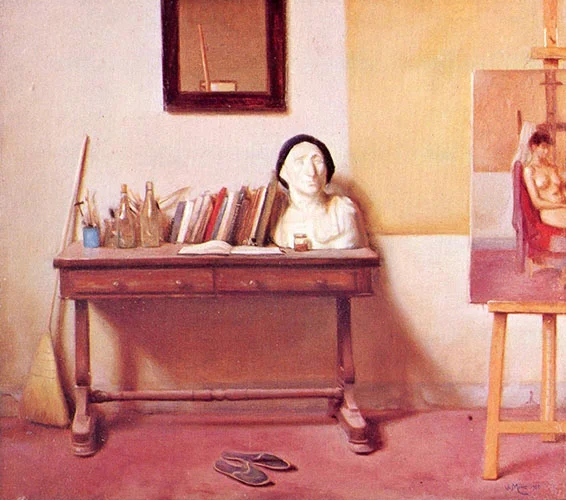
Ben Long’s Studio in Florence with his painting of a nude, 1981. Oil on panel, 9” x 11”. Private collection, US. Image courtesy of: D. Jeffrey Mims.
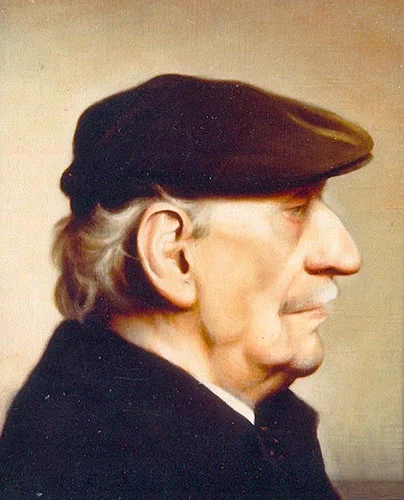
Portrait of Gastone, 1981. Oil on panel, 10” x 8”. Private collection, US. Image courtesy of: D. Jeffrey Mims.
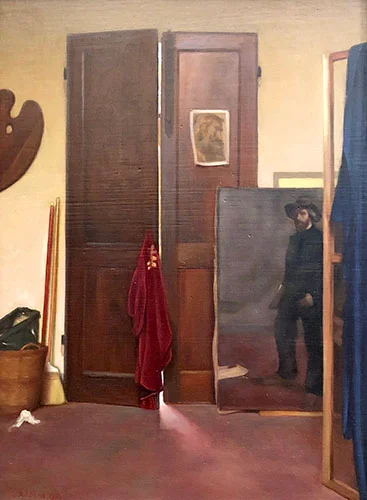
Ben Long’s Studio in Florence with his portrait of Rob Wraith, 1981. Oil on panel, 16” x 20”. Private collection, US. Image courtesy of: D. Jeffrey Mims.
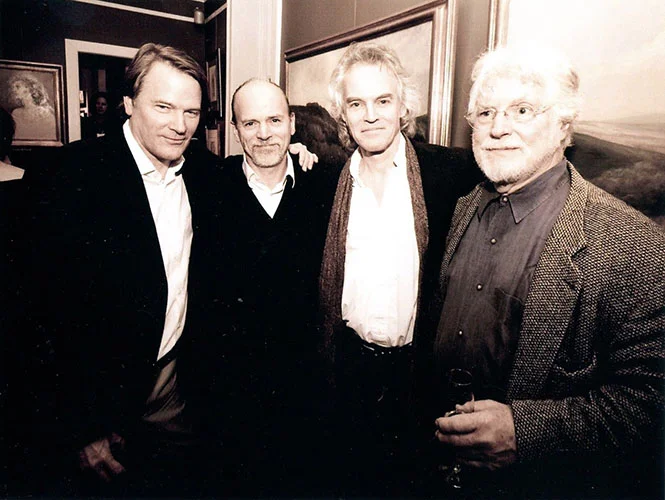
Mr. Mims at the opening of his group exhibition titled ‘Maestros’ at Ann Long Fine Art in 2008 (l-r: Charles Cecil, Daniel Graves, Mr. Mims, Ben Long). Image courtesy of: D. Jeffrey Mims.
Following on from your time in Florence, you would come to visit Rome for a second time where you saw the Eternal City and its surroundings in a new light. How did your perception of Rome change on this second trip?
Odd as it may sound at this moment in my story, I have never enjoyed travelling. I have enjoyed the privilege of being able to live in a number of different locations and to learn from each experience, but my inclination is to belong to and become thoroughly acquainted with the place where I live. This peculiarity (as well as my limited funds) probably explains why I never visited many of the other well-known Italian destinations. Nevertheless, as my first year in Italy moved nearer to a conclusion, a curiosity about what Rome had to offer took hold of me and I made a return trip there to explore future possibilities.
My first impression on arrival was the squalor surrounding the central train station. A memory of Rome from several years earlier had been shaped by my determination to see as many of its artistic treasures as possible in a limited time, so I was less aware of anything else. But on this visit as I began to learn my way around, I discovered a number of charming and less travelled quarters of the city. There were whole neighborhoods that felt disconnected from the tourism and commerce that often surrounded the more famous landmarks. Even many of the grand public spaces which had been teeming with humanity by day could be visited in relative solitude with late night visits. To my mind, the churches, palaces and gardens of Rome that had evolved from the designs of antiquity, offered an elevated role for the painter—the decoration of public spaces.
At the time, I don’t believe I could have explained exactly what continued to draw me to Italy in the following years, but my eventual choice to pursue and teach mural painting and architectural decoration certainly owes no small debt to the lessons absorbed—directly or indirectly from the examples I saw daily in Rome.
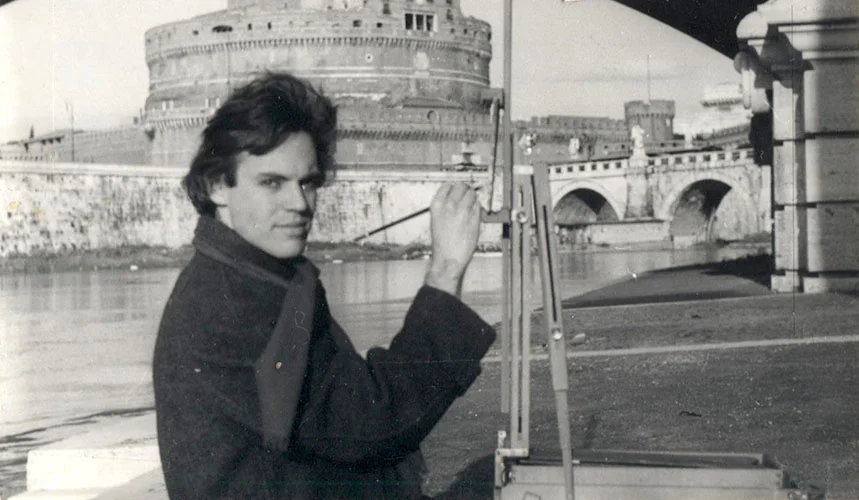
Mr. Mims landscape painting in Rome with the Castel Sant’Angelo behind him. 1984. Image courtesy of: D. Jeffrey Mims.
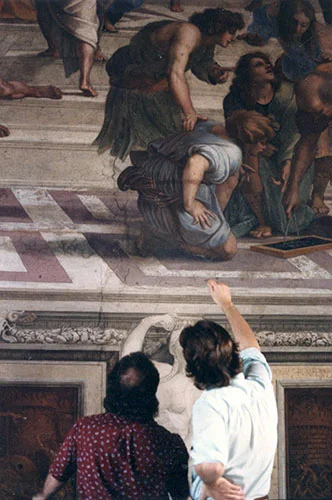
Mr. Mims in the Vatican Museum studying Raphael’s, School of Athens. 1984. Image courtesy of: D. Jeffrey Mims.
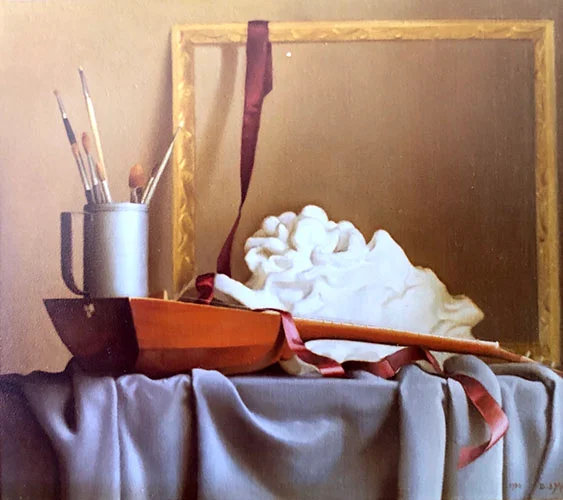
Still life with Balalaika, 1979. Oil on canvas, 16” x 20”. Private collection, US. Image courtesy of: D. Jeffrey Mims.
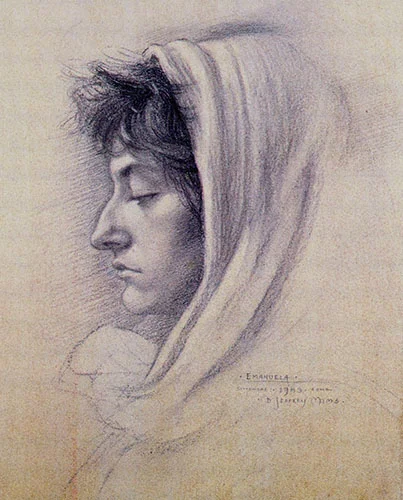
Portrait study for 1983 fresco (sewing figure), 1983. Charcoal and graphite on toned paper, 15” x 11”. Private collection, US. Image courtesy of: D. Jeffrey Mims.
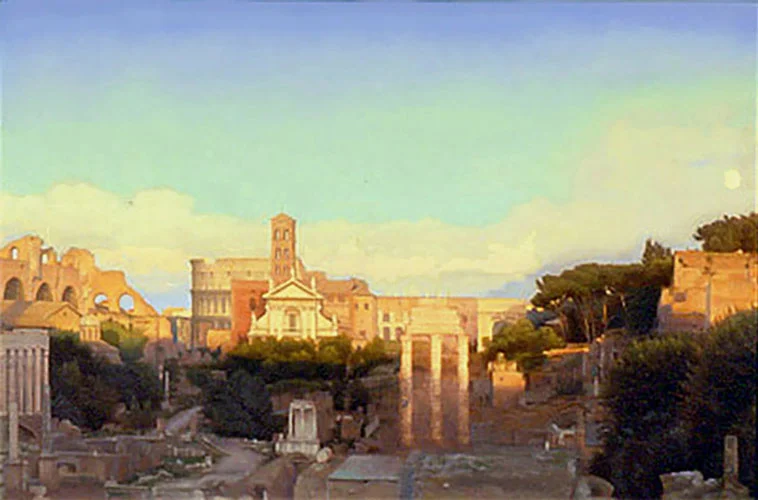
Landscape of the Roman Forum, 1986. Oil on canvas, 18” x 27”. Private collection, US. Image courtesy of: D. Jeffrey Mims.
In 1982 you departed Italy and returned home to Southern Pines, NC. Full of inspiration from your study with Ben Long and his associates, as well as the time you spent gathering pieces of the Classical and Renaissance traditions from Florence and Rome, you begun your professional career as an artist with a profound respect for the forebearers of the Renaissance and nineteenth century academic tradition. Can you recollect these years and the trials and tribulations of establishing yourself as a practising artist?
With the last of my savings dwindling, it was time to leave Italy and return to my hometown. This must have been around the beginning of 1982, marking ten years after my graduation from high school. I would note here that to commit ten years of study to establish oneself as a painter would not have been an unusual amount of time in earlier centuries. Neither is it considered out of the ordinary in today’s culture for certain other professions.
While there is risk in any career choice, the path of the artist seems to have always been one with more uncertainty than most. Even when there has been patronage with the background, knowledge, and purpose to commission great works—and the artists with the training and genius to create those works—success has been reserved for the few.
I wonder if other professionals consider themselves truly prepared at the beginning of their own careers? For me, the transformation from student to practicing artist was never a well defined moment. The independent course of study that I and others of my generation have had to piece together, has confirmed for me the belief that any good education is one that teaches how to continue learning.
My first public commission happened shortly after my return home where I had moved back in to live with my parents. The proposal was certainly not what I might have expected, yet it proved to be an interesting and valuable learning experience. Our local Arts Council was re purposing a downtown movie theatre into a Performing Arts Center. A local architect had already made drawing proposals to upgrade the façade of the building. I was asked if I might execute a trompe l’oeil mural based on his design. This was hardly my idea of a proper mural commission, but in the spirit of community goodwill, I accepted the work for a minimal fee. With the help of a good friend, I spent the next several months climbing scaffolding to paint a series of false windows and moldings on a monumental scale for which I had no experience—at a height that would make me dizzy today.
Not long after completion of this project, I was able to rent a small room in the historic center of Southern Pines for use as a studio. Here I began several independent easel paintings, similar to what I had painted in Florence, a studio interior, portraits of friends and the occasional small still life. Now that I was no longer surrounded by the romance of life in Europe, I struggled with the translation of all I had experienced up to this point. At least I was in good company. Painters, sculptors, and architects from at least the time of Durer have been confronted with this same problem—how to translate what had been gained from the pilgrimage to Italy back into their own work and culture.
As I recall, it was at this time that I received my first portrait commission. It quickly became clear to me that portrait painting could command a better price than had been possible from the sale of a still life. Over the next few decades, I came to rely on the occasional portrait commission as a way to support periods of travel and study. I use the term ‘occasional’ because unwilling to work from photography, my portrait contracts required a minimum of twelve three-hour sessions to be held at my Southern Pines studio. Not many modern schedules were willing to accommodate such conditions, but there were just enough sitters to make possible a return trip to Italy for part of each year.
Another first for me was a gallery exhibition in 1982. McKenna Gallery (back then it was called Gaston McKenna Gallery after the two sisters who ran it) in Charlotte, North Carolina was representing Ben Long and his British colleague, Rob Wraith. With this introduction, a solo exhibition of my work was arranged. The paintings were mostly small panels completed during my time in Florence and as they were moderately priced, all were sold on opening night. (As a side note: Four years later, an exhibition would be held at the same gallery of the full-scale cartoon drawing with related studies from my 1983 fresco project).
But then, another unexpected thing happened while I was back in North Carolina. One day a letter arrived from the priest who had commissioned Ben to paint the fresco in Glendale Springs two years earlier. As it turned out, Ben Long’s fresco had gained a great deal of notoriety during this time. Tourists came by the busloads to see the fresco. I have been told that at one count the church was receiving more visitors per year than the state’s art museum. This little mountain church, which had initially seemed such an unlikely choice had become a tourist destination of such reputation that donations came pouring in, enabling a complete restoration of the building. The restoration led to the addition of a new chamber beneath the sanctuary, called the undercroft where a wall of modest size had been prepared for a new fresco. I was invited to fresco that wall.
The actual subject and design for the work was left entirely to me. The commission was dedicated to the memory of a young girl from the congregation who had been struck and killed by a truck near the church. I chose a theme of departure. Once the multi-figure composition was determined, I began making detail drawing studies using friends and volunteers as models.
The year was 1983. I was 28 and determined to return to Italy where I planned to begin work on the full-scale cartoon drawing. Collecting the studies I had made so far and changing what money I had saved into traveller’s checks, I boarded a flight back to Rome. Finding a place to live and work was my first priority. Since the only lead I had was the address of the American Academy in Rome, I presented myself to the gatekeeper with the improbable hope of finding accommodation. To my surprise I was admitted to an office and given the address of an Italian family who owned an apartment for rent nearby (with the understanding that all communication would require my still rudimentary Italian).
For the next half year this apartment would be my home, (to which I would return on several future trips). My days were spent visiting museums and churches for inspiration and at night I worked on the transfer of drawing studies to the full-scale cartoon. To better understand the lighting and relationship of figures to architectural setting, I built a small model with clay figures—a method which had been practiced by Poussin and others.
As a result of that visit to the American Academy in Rome, I would meet and became friends with Edward Schmidt. Ted had been awarded a fellowship at the Academy that year and I am indebted to his help in working out the more complicated elements of perspective for my design. His own paintings evoke a world of classical mythology and invention—that element of painting so highly prized throughout the history of Art. Ted’s unique work offers a much needed antidote to the more prosaic emergence of contemporary realism. Not every great Painter is a great Artist and Ted’s finest work represents both.
With this first phase of my studies well underway, it was time to return to North Carolina. Fresco is not an art well-suited to the timid or the inexperienced painter—but the optimism of youth is a strong motivator. On my return to the mountain community of Glendale Springs, I began to prepare the materials that would be needed, washing sand, ordering the lime, grinding and testing various colors as Ben had taught us to do. Following his lead as well, I was able to incorporate several local models for the remaining portrait studies while the technical preparations were underway. The combination of my inexperience and my enthusiasm for the challenge of fresco led me to accept a fee for little more than the price of materials for what would develop into a year-long project.
I had not foreseen the challenge of working at this scale (10 x 12 feet) without a support group. Following several months of completing the cartoon drawing in situ, a full-scale tracing in outline was transferred to the prepared plaster wall (arriccio). This was done in the traditional manner of pouncing powdered pigment through holes pricked along the outlines of the design. These dotted lines were then fixed to the wall with a thin underpainting of earth red pigment and water (sinopia). Next, a layer of fresh plaster (intonaco) was applied, section by section, to receive the same transfer process before the actual painting could begin. Because of my limited ability with the art of plastering, and working with only one helper, each section often took a 24-hour period to complete. Occasionally, when the plaster had dried and the desired effect could be judged the following day, the results were unsatisfactory. In this instance the only recourse possible with fresco is to scrape the plaster back down to the original arriccio layer and start all over again—a learning experience I endured more than once.
To avoid the distraction of tourists, I developed the habit of working at night and sleeping by day (a vampire schedule I have maintained to this day whenever possible).
Following shortly after the fresco’s completion, a surprise letter arrived in the mail inviting me to receive an award for my work. Apparently, word had reached someone in NYC where an organization called ‘Classical America’ had two years earlier created the Arthur Ross Awards to ‘recognize and celebrate excellence in the classical tradition.’ The evening affair was held at the National Academy of Design and the award was presented by Philippe de Montebello, director of the Metropolitan Museum. It was, no doubt, the novelty of the ancient medium combined with the targeted mission of Classical America behind my being selected for this honor—still it felt like a rewarding conclusion to a journey I had begun many months earlier.
Throughout the 1980s there would be several other mural projects, but these were commissioned as oil on canvas. During this decade, the portrait work gradually shifted from paintings to drawings until I was finally able to retire entirely from such work. The mural projects now financed my return trips to Italy where I sought inspiration for their preparatory stages. As these projects required ever larger spaces, my visits to Rome were eventually replaced with a return to Florence. My friends Charles Cecil and Daniel Graves had recently pioneered one of the first independent art schools there (Studio Cecil-Graves). They arranged the use of a large historic studio complex that was made available to me during the summer months when the school was closed. The building had originally been a church before being adapted into a studio complex in the 1800s for the sculptor Lorenzo Bartolini. This arrangement provided ample space for large scale work. Eventually, Charles and Daniel agreed to form separate schools. In 1991 Dan formed the Florence Academy of Art in a new location where I was invited to run the first Summer Program, and the Charles H. Cecil Studios has continued in the original location.
I should perhaps mention here that on several occasions during my Italian pilgrimages I had the privilege to visit with Pietro Annigoni toward the end of his life at his studio in Florence. The following is what I recall from my first visit. There was a distinct protocol for how one would proceed. First, I would phone his secretary, a gentleman named Palmiro who issued a date and time. On the appointed day I rang the doorbell and identified myself over the speaker. Then a loud ‘clack’ as the front door was unlocked by a rope and pulley system which had been devised to avoid the need of running up and down the stairs. Up this dark staircase I entered and was admitted to a room where several people sat in silence, waiting for what seemed like an audience with the Pope. When at last my name was called, I was directed to an office where sat the Maestro—behind a desk, his massive bulk backlit against a window—creating the effect of being cloaked in darkness. For those familiar with the film The Wizard of Oz, picture if you will, the moment when the weak-kneed Scarecrow approached the throne of the Great and Powerful Oz, and you will have some sense of my first encounter. It was a cold and rainy autumn morning and though I was fairly well drenched I had managed to protect my portfolio—which Annigoni indicated I was to open and show him. I will always remember his first phrase to me “E una brutta giornata” (It’s an ugly day) spoken while I was fumbling on the floor with the loud, dripping, crinkly plastic that I had wrapped around my portfolio. Looking up I quickly replied (in Italian)—"for me it’s a beautiful day because I have waited so long to meet you!” His demeanor changed in an instant and suddenly that shadowy, intimidating legend I had feared seemed more like a kind grandfather figure. He patiently looked over several of my drawings and paintings, obliging me with a few polite remarks and even complimented my Italian. I found Annigoni to be a courteous, if somewhat reticent gentleman who was always willing to lend a helping hand to young artists like myself. His response to one of my letters from 1984 (see image below) demonstrates his generous nature, familiar to those who were fortunate to have met him.
As the 1990s progressed and my focus shifted to the development of my easel painting, the trips to Italy became fewer. The public mural work had provided lessons that could not be learned from easel painting, but the time seemed right to reconsider my independent studio work. Traditional painting was at this time beginning to find acceptance again in certain circles and there remained much of the craft that I hoped to explore. In 1995 I would be invited along with Ben Long, Richard Maury and Nelson Shanks to participate in an exhibition titled ‘The Spirit and the Flesh’ held at Oglethorpe University Museum of Art in Atlanta Georgia.
My work during this period was eventually represented by one of the top galleries in New York for a short while, however, I had made the decision years earlier (for reasons beyond the scope of this interview) that commercial gallery representation would play only a limited role in my own career. Perhaps I should say, ‘in my search for a career’ because there really is no established market for the contemporary traditional painter.
Nevertheless, an awareness of and appreciation for traditional training among younger students was creating the demand for an education no longer offered in university art programs. As Ives Gammell foresaw in his book, ‘The Twilight of Painting,’ “this situation would need to be resolved from a century of wilful neglect through the independent efforts of a few.”
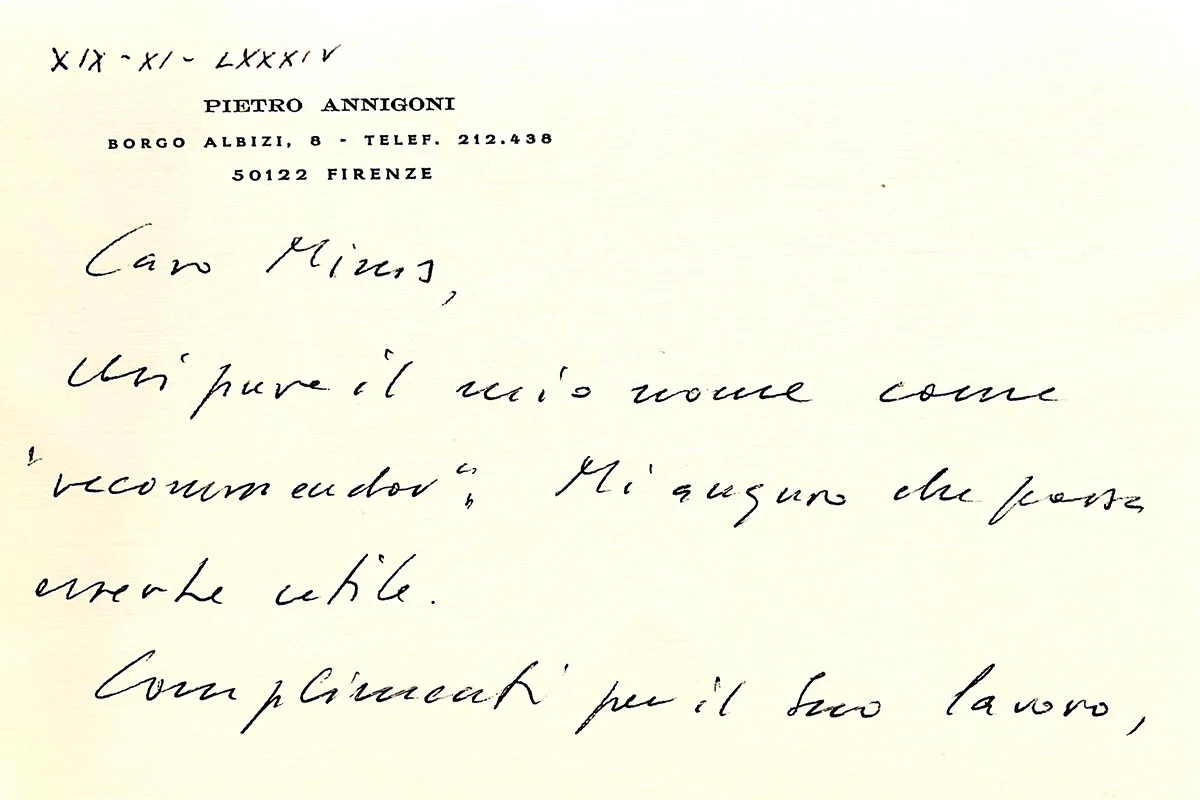
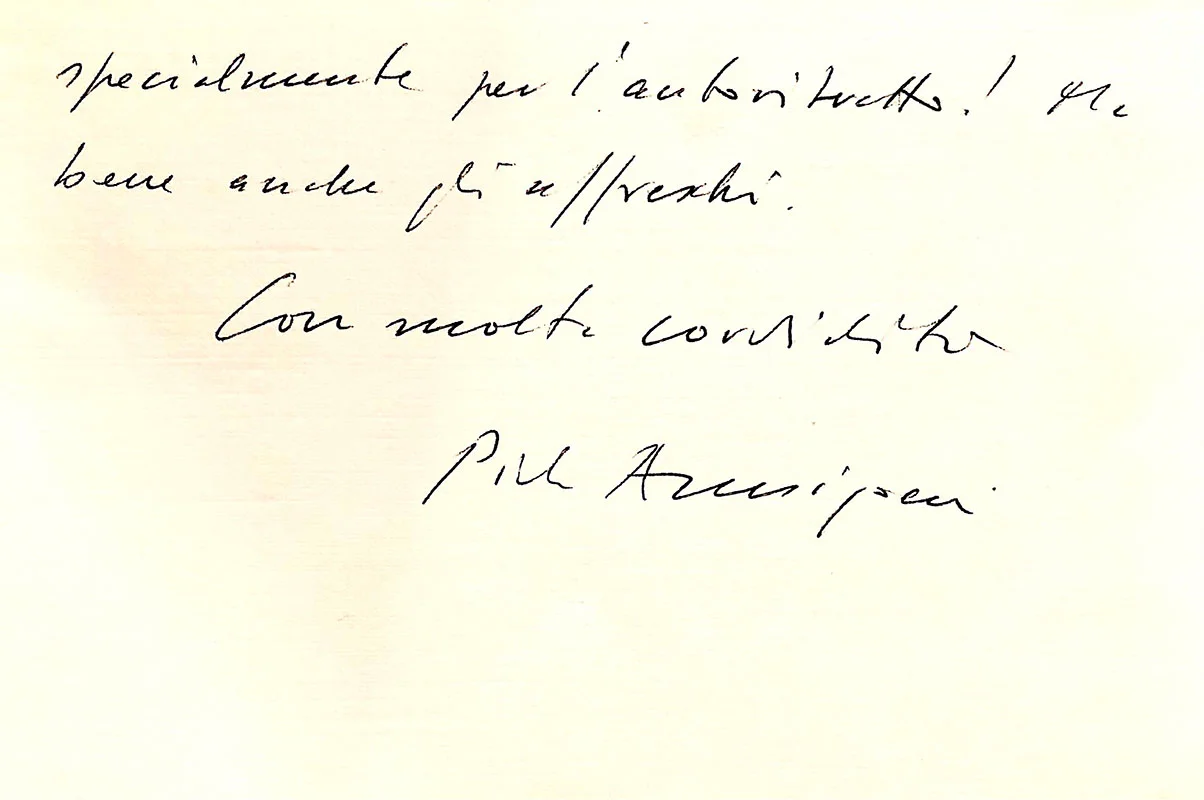
A letter from Pietro Annigoni to Mr. Mims from November 19, 1984. Image courtesy of: D. Jeffrey Mims. Translation: “Dear Mims, You can use my name as a recommendation. I hope it will be useful. Congratulations on your work, especially the self-portrait! I also like the frescoes. Very cordially, Pietro Annigoni.”
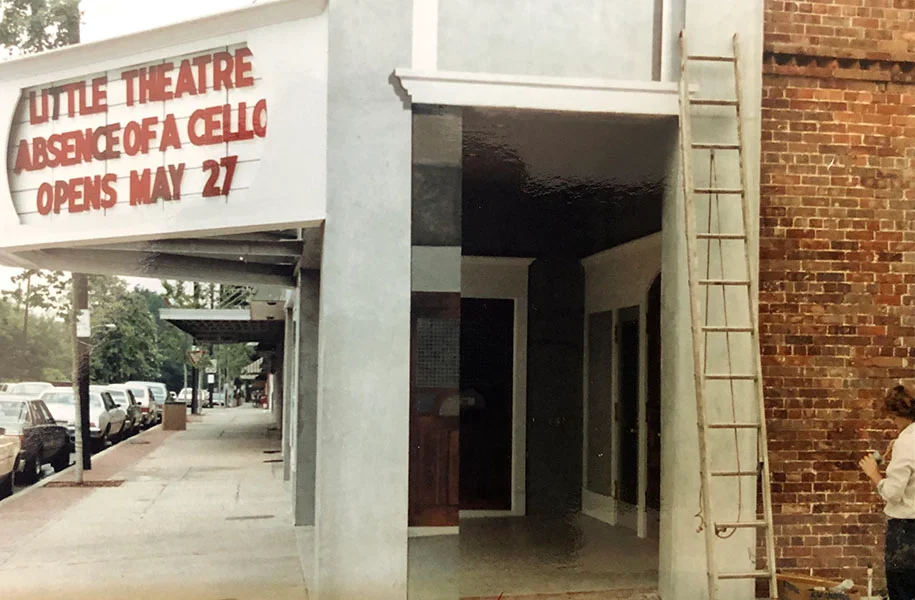
Mr. Mims’ trompe l’oeil mural representing false windows and moldings, painted on the façade of the local Sunrise Theatre in downtown Southern Pines, NC. 1982. Image courtesy of: D. Jeffrey Mims.
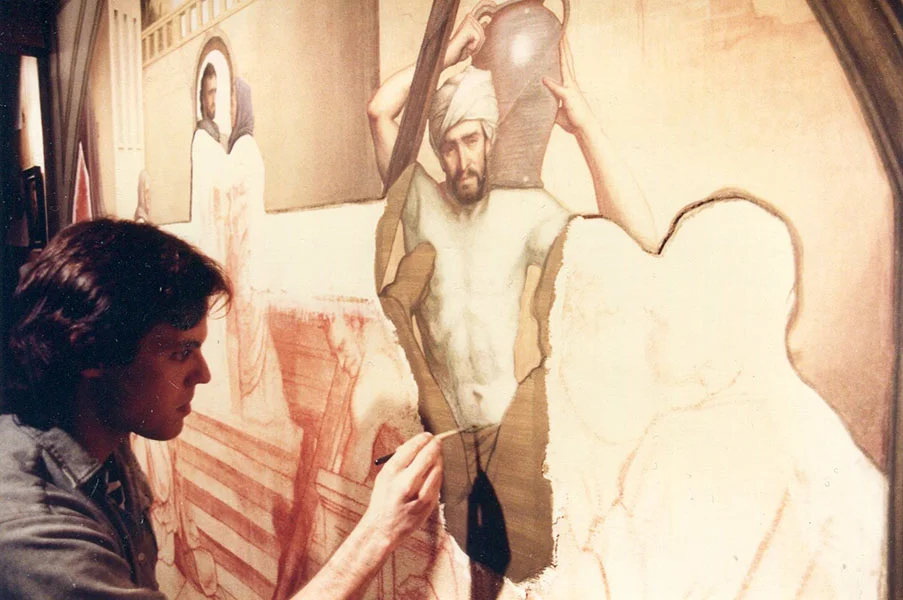
Mr. Mims working on his fresco within Holy Trinity Episcopal Church in Glendale Springs, NC. 1983. Image courtesy of: D. Jeffrey Mims.
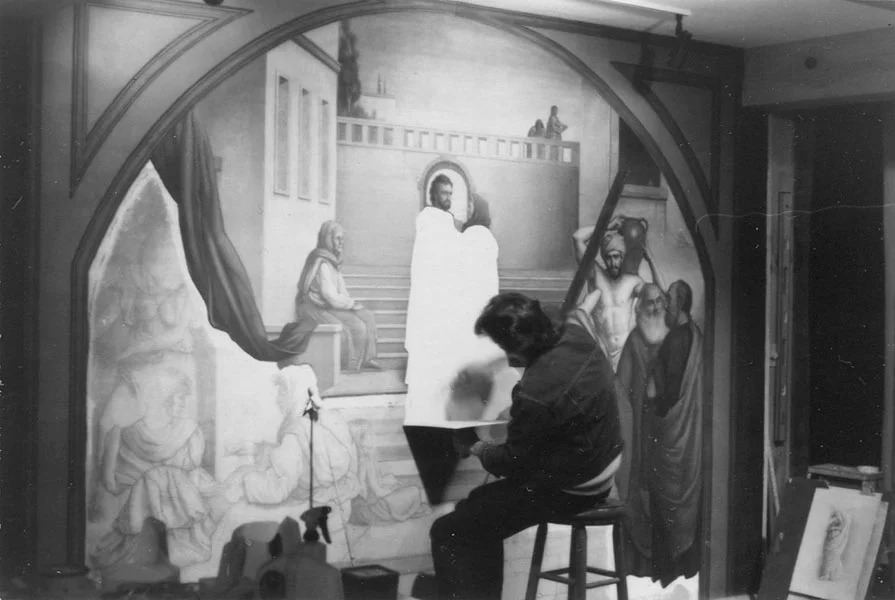
An alternative view showing Mr. Mims working on his fresco within Holy Trinity Episcopal Church in Glendale Springs, NC. 1983. Image courtesy of: D. Jeffrey Mims.
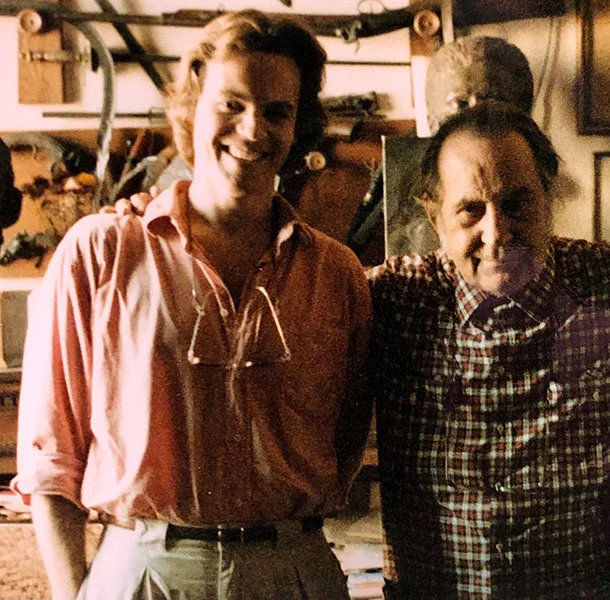
Mr. Mims standing beside Pietro Annigoni within Mr. Annigoni’s studio in Florence, ITA. 1984. Image courtesy of: D. Jeffrey Mims.
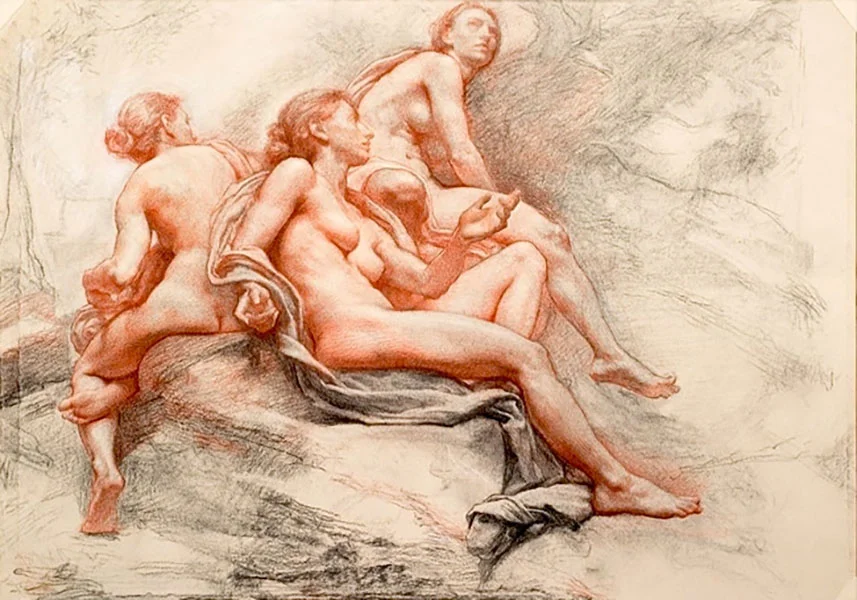
Three Figure Study, 2006. Charcoal and sanguine on paper, 14” x 18.75”. Private collection, US. Image courtesy of: D. Jeffrey Mims.
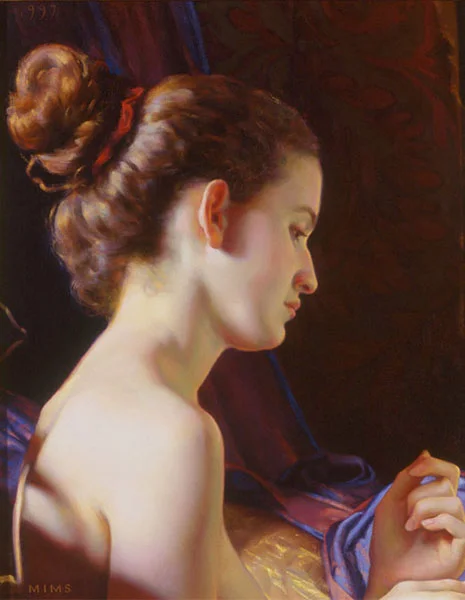
19, 1997. Oil on canvas, 20” x 25”. Private collection, US. Image courtesy of: D. Jeffrey Mims.
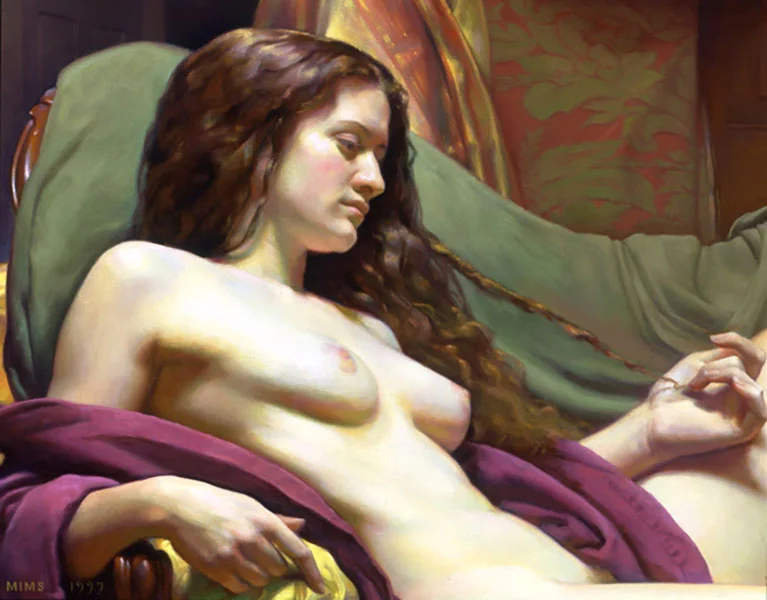
India, 1997. Oil on canvas, 20” x 25”. Private collection, US. Image courtesy of: D. Jeffrey Mims.
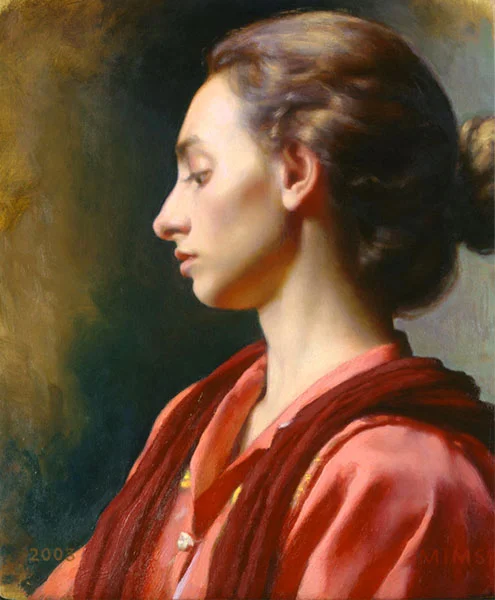
~A, 2003. Oil on oak panel, 12” x 10”. Private collection, US. Image courtesy of: D. Jeffrey Mims.
After establishing yourself as a practicing artist and having many rich experiences which helped you refine your technique and aesthetic awareness of the Classical and Renaissance traditions, like many artists who came before you, you felt the urge to pass on what you had discovered. Therefore in 2000, you established Mims Studios in Southern Pines, NC, which was the precursor to the Academy of Classical Design that started in the same location. Can you provide information about your initial vision for the academy and how you set it up?
Through the 1980s and 90s I had occasionally taught privately or worked with a few talented students who assisted me with the mural commissions. Several, like Kamille Corry from Utah, have since established very fine reputations of their own. As a new century began and the internet created new approaches to communication, the time seemed right to establish an independent school of art and share what I had learned at a more formal level. My goal was to make available the kind of training and environment that I might have wished for as a student. What began as Mims Studios in 2000 developed by the next decade into the Academy of Classical Design. Much of the basic training has been similar to that of other private ateliers influenced by the 19th century French model, but with a different emphasis—directed toward mural painting and architectural decoration. Illustrated lectures were presented each week to show how different traditions of painting and sculpture have enriched the interior designs of architectural spaces and the study of classical ornament was revived as part of an artist’s training.
The concept of ‘bel composto’ or ‘beautiful whole’ associated with Bernini was of increasing interest to me at this time. But the role of painting as a supporting design element can be seen in many other European building projects as well—often with regional developments of their own. As with most all artistic developments, they share a foundation through much earlier classical models.
These historical examples served as inspiration for the Academy’s new studio location in downtown Southern Pines which was remodelled and adapted to function as a school of art. I re-designed the interior to reflect (on a much more humble scale) the presentation spaces of an art museum. My own training had taken place in some of the most iconic museums of the Western world. Even though my focus at that time had been on the individual works displayed in these buildings, I couldn’t help but notice that the surrounding spaces served to elevate the total viewing experience. It was, in effect, a secondary education in architectural appreciation. Certainly, the designers of public buildings in the US like the Metropolitan Museum of Art in New York or the Jefferson Building at the Library of Congress in Washington, DC (to name just two) understood the importance of the ‘beautiful whole’ as an indirect education in the visual arts.
While much progress in traditional painting has been achieved within the past several decades, my own goal in creating such a specialized educational model has been to bring attention to a historically important role for the painter and to encourage possibilities for its future development. As of July 2022, the school is temporarily closed to accommodate the painting of the ceiling vault. Organized into a series of panels, a theme representing the painter’s education moves from Imitation to Imagination. When I say that the ceiling narrative ‘moves from Imitation to Imagination’, I should describe it as more a circular path than linear. A natural sense of imagination seems to be something all children are born with–but often lost along the way. The best art maintains a balance of both.
The panels are being decorated with figurative and ornamental imagery. Anchoring the four corners of the room are mirrored acanthus figures holding signs for each of the four elements of painting—Drawing, Color, Composition and Invention. The two lunettes at each end of the room will hold allegorical figures to personify each of these four elements—Drawing and Color under Imitation—Composition and Invention under Imagination.
Above each wall easel the names of famous artists are inscribed between flanking acanthus griffins which are woven into a rinceau frieze. Once the entire ceiling design has been established with painted outlines, a trompe l’oeil technique will then be applied to each of the figurative areas—simulating the effect of low relief stucco.
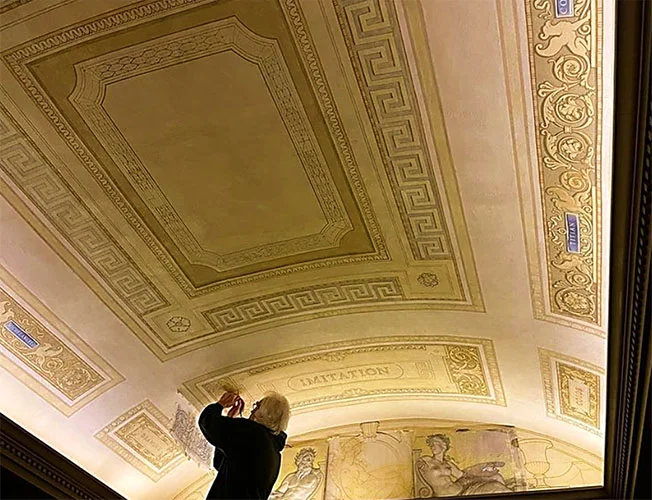
Mr. Mims carrying out work on the ceiling vault at the Academy of Classical Design in Southern Pines, NC. 2023. Image courtesy of: D. Jeffrey Mims.
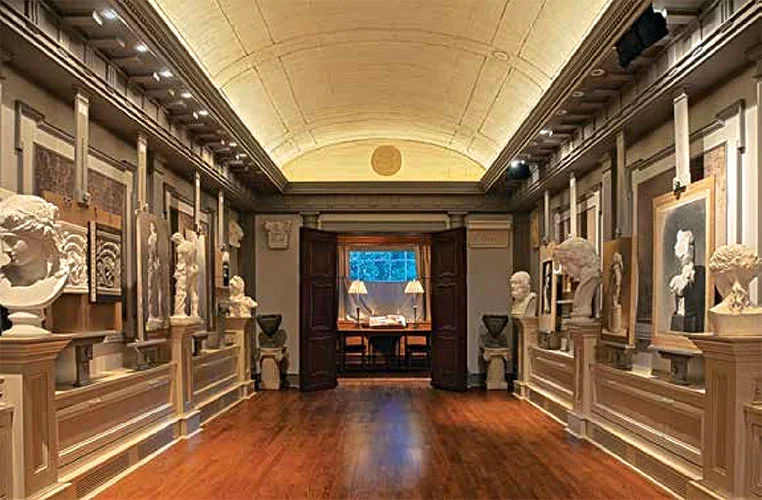
The main entrance and Cast Hall of the Academy of Classical Design in Southern Pines, NC. 2014. Image courtesy of: D. Jeffrey Mims.
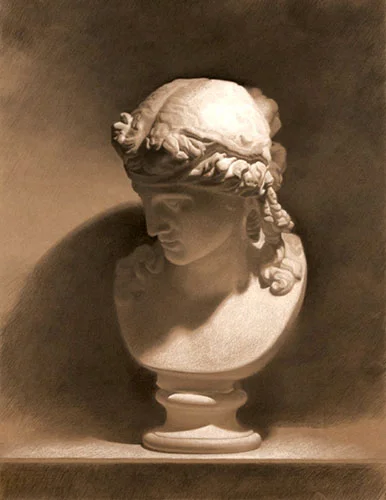
Rodney Wilkinson, Ariadne, c.2013. Charcoal and white chalk on toned paper, 34” x 28”. Private collection, US. Image courtesy of: D. Jeffrey Mims.
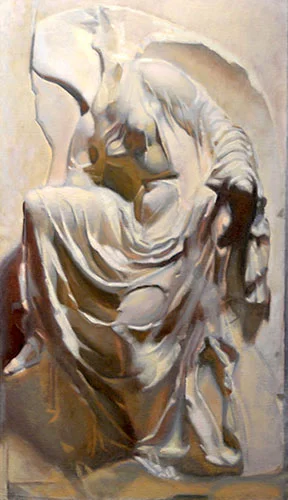
Mari DeRuntz, Nike Adjusting Her Sandal, c.2008. Oil on canvas, 44” x 24”. Private collection, US. Image courtesy of: D. Jeffrey Mims.
Concerning the course of training your offered at the Academy of Classical Design, an aspect which distinguishes your curriculum from other academies is the focus on classical ornament and architectural decoration as part of an artists’ training. Why have you felt the need to include these areas of study as part of your curriculum and can you explain how it fits into the total context of study in the academy?
Let me begin my answer with a quote from Kenyon Cox (1856-1919) which he gave in ‘The Classic Point of View’ (1911):
“If I could have my way in the training of young artists, I should insist upon their spending a good deal of time in the study and designing of pure ornament that they might learn how independent fine design is of its content and how slight may be the connection between art and nature.”
No one understood this better than the mural painter who traditionally worked in fresco on plaster. This situation required spending time in the architectural spaces being decorated. History’s finest artists would design painted images to compliment the geometry of interior spaces—and use the interior to showcase their paintings. No less an authority than Henry Hope Reed, the original founder of the Institute of Classical Architecture and Art, considered the decoration of architectural space to be the ultimate application of the painted and sculpted figure. In this regard, the human figure is one of many design elements (along with framing, painted borders, geometric patterns, festoons, and other ornamental devices from classical times) used to enrich and express the purpose of a public building. Learning the language of ornament also strengthens the intellect and imagination needed to draw the figure. In turn, drawing from the figure can enhance form and subtlety in the modeling of ornament, even as it confirms the artist’s ability to conceptualize geometric solids in space.
I often say it is my belief that—to divide space and then ornament it—is the underlying foundation of each of the fine arts. Understanding design in this way, an artist like Michelangelo was able to direct his genius to create variations of ornament, the decoration of a ceiling, the construction of a cupola, or even the arrangement of an entire public space as he did with the Piazza del Campidoglio in Rome.
The inclusion of Ornament in my curriculum was like everything else I offered—only an introduction to a lifetime of research and practice—mostly through lectures intended to acquaint us with the quality and variety of historic artworks. Sight-Size was employed—but only because I found it to be the fastest way to achieve a standard level of quality. Projects would progress to free-hand drawing for my advanced students. I never encouraged mechanical measuring with either approach—always hand/eye/mind. Leighton reminds us that “the simply imitative faculty, is the lowest gift of the artist” and that an educated imagination is the goal. I recognize that there is no shortage of undisciplined ‘imagination’ out there, but it seems to be lacking in the knowledge, taste or inspired inner voice to guide it.
I also share the following with my students—in my experience—the more we learn—the sharper our perceptions grow—and the less satisfied we are with what previously seemed acceptable. On the other hand, as our awareness of the world’s finest artwork expands, it provides a haven of beauty and never-ending inspiration to keep us going.
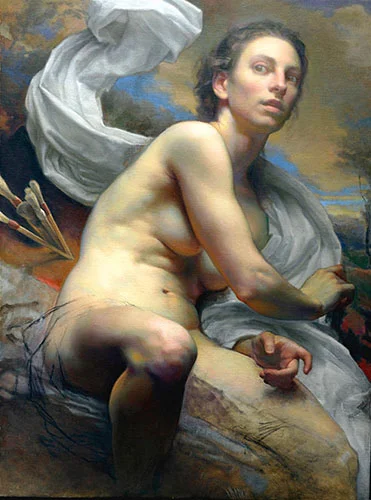
Allegory of Painting, 2009. Oil on canvas, 32” x 24”. Private collection, US. Image courtesy of: D. Jeffrey Mims.
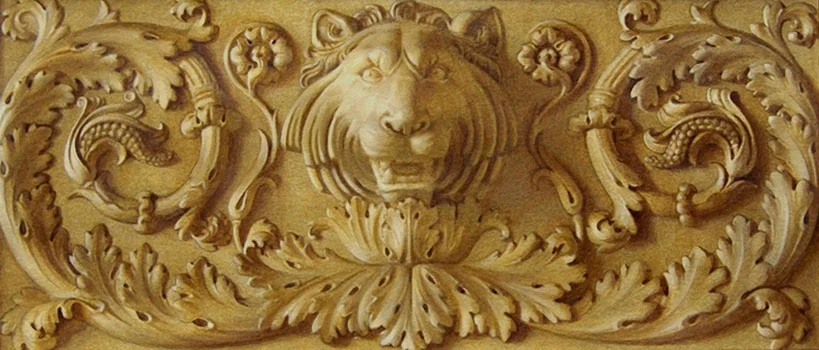
Drawing of Lion Fountain in the American Academy in Rome, 2009. Mixed media on paper, 6” x 13.5”. Private collection, US. Image courtesy of: D. Jeffrey Mims.
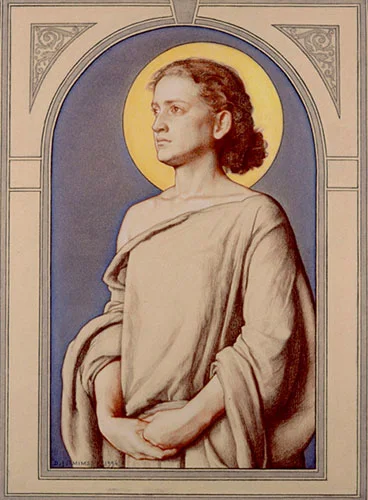
Faith, 1996. Charcoal and coloured chalks on toned paper, 24” x 15”. Private collection, US. Image courtesy of: D. Jeffrey Mims.
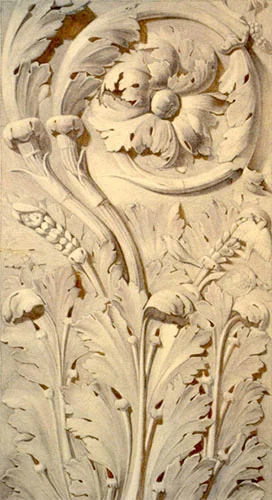
Ali Sexton, Ornament, 2013. Ink and graphite on toned paper, 20” x 12”. Private collection, US. Image courtesy of: Jeffrey Mims.
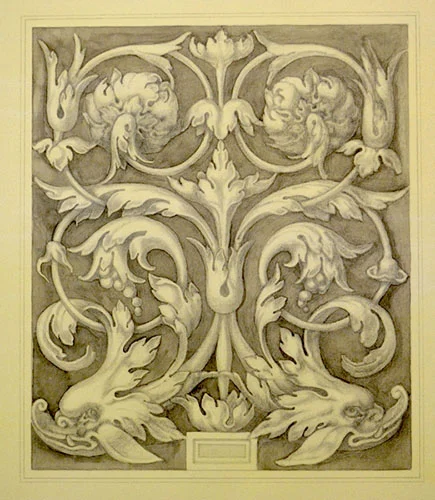
Rodney Wilkinson, Ornament, 2013. Ink and graphite on toned paper, 20” x 14”. Private collection, US. Image courtesy of: Jeffrey Mims.
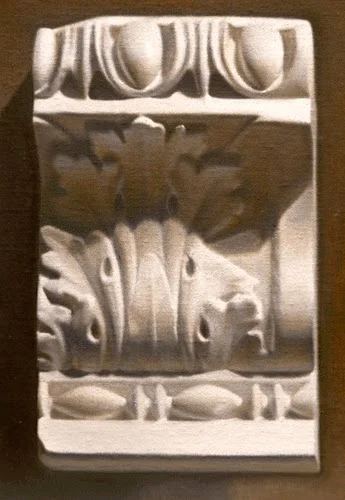
Christian Nieto, Ornament, 2013. Oil on canvas, 18” x 11”. Private collection, US. Image courtesy of: Jeffrey Mims.
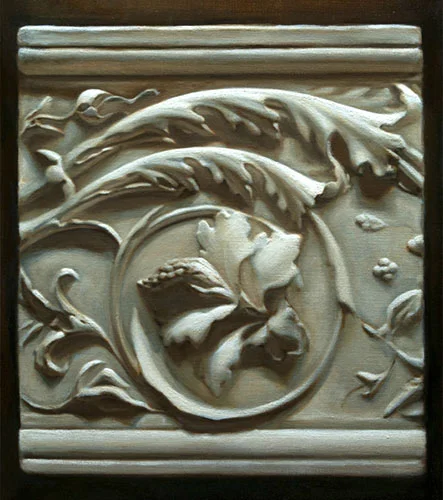
Lane Koster, Ornament, 2013. Oil on canvas, 20” x 18”. Private collection, US. Image courtesy of: Jeffrey Mims.
Looking towards the future, what do you hope to achieve with your own personal work as you enter the later years of your life?
In 2009 I was granted a three-month Affiliated Fellowship at the American Academy in Rome. It was during this period that I conceived the idea of creating a Mural Guild—an advanced program to guide atelier training into the realm of mural work and the decoration of public spaces.
By the spring of 2020 this objective was recognized with the first ever award for pedagogy at the Southeast Chapter’s 14th annual Shutze awards by the Institute of Classical Architecture and Art. My idea was to use the vaulted ceiling of the newly re-modeled academy Cast Hall as an apprentice program for advanced students to train as a working Mural Guild. The result would be a prototype for future projects and hopefully employment opportunities for the students involved.
Then the COVID-19 pandemic struck, enrolment dwindled and together with other circumstances in my life, it became clear that such a project would no longer be possible. I would need to close the academy and re-think my own future plans. The ‘silver lining’ was an opportunity to focus full-time on a more cohesive design program for the ceiling vault which I would now begin with one assistant, Ali Sexton, who remained to help me with the initial stages.
At the time of this interview, I have reached the age of 70 and fortunately am still able to climb the scaffolding each day to work on this project. I expect it to occupy me for the next several years. How the space will eventually be used or what I will do afterwards remains a mystery. In many ways it reminds me of my earlier decision at age 17 to trust instinct and pursue the unknown.
Our grateful thanks go to Mr. Mims for taking the time to respond to our questions and for sharing insights into his life and work. Through his example as a painter, educator, lecturer and muralist, he has proven that the classical tradition still has relevance in our current day and age. We wish Mr. Mims the best of luck as he continues developing his work into the future.
Mr. Mims school’s website: www.academyofclassicaldesign.org